
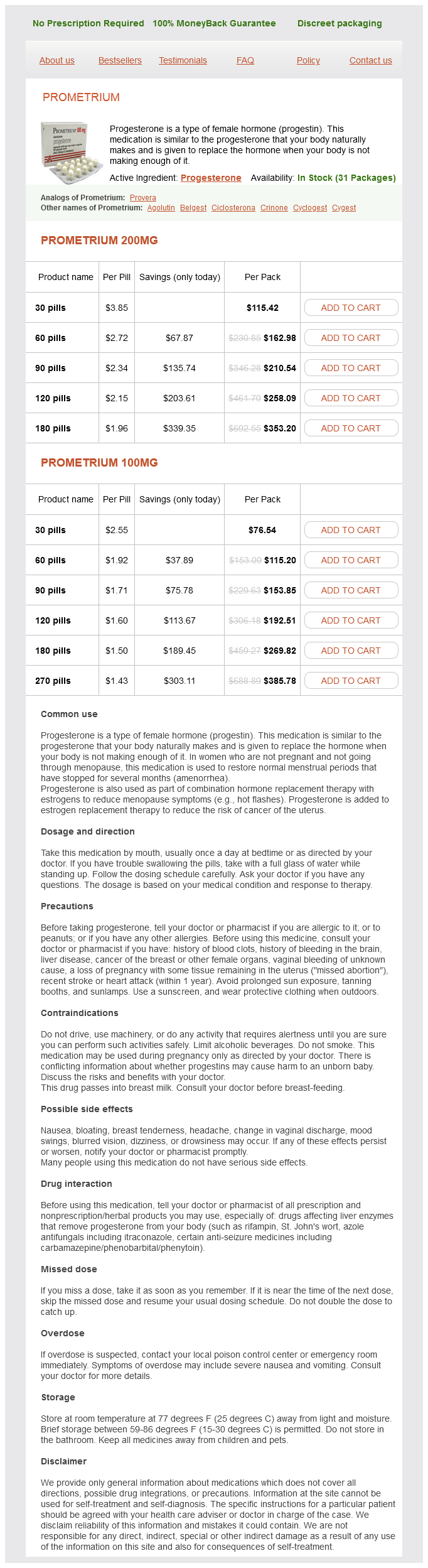
"Prometrium 200 mg, treatment as prevention".
A. Runak, MD
Medical Instructor, University of Texas Southwestern Medical School at Dallas
Linear accelerator-based machines (linacs) applied these advances to use microwaves to accelerate electrons onto a tungsten target and emit a fraction of their kinetic power as mega-electron volt power X-rays medications used to treat migraines prometrium 100 mg discount visa. Advantages of linacs over cobalt-60 embrace larger dose charges medicine allergic reaction purchase prometrium 100 mg online, sharper beam edges medicine of the prophet prometrium 200 mg buy line, higher energies medicine for uti prometrium 200 mg amex, and simplified radiation safety. This allowed simple therapy geometries to be simulated and two-dimensional (2D) radiographs of the patient in the planned place might be acquired (7). These images are transferred to a treatment planning laptop system to create a treatment plan. Treatment planning: two- versus three-dimensional Classical (also often identified as 2D or conventional) and fashionable 3D remedy planning share the ideas of using imaging to outline goal volumes, setting beam parameters to irradiate targets and keep away from wholesome tissue, and making correct dose calculations; nevertheless, completely different applied sciences are used. Target definition in classical therapy planning used radiographs to define a rectangular target area. At the top of this process, a 3D mannequin of the patient anatomy has been constructed. The contoured model of the patient is used to design a personalized treatment plan. The objective is always to plan a high, therapeutic goal dose whereas minimizing regular tissue toxicity. The parallel-opposed pair approach uses two beams, one coming into from the anterior and one posterior. The resulting dose distribution is a comparatively uniform column of dose from the anterior to posterior of the affected person. The four-field field approach makes use of 4 beams, with one entering although every of the anterior, left, posterior, and right instructions. The resulting dose contains a uniform box-shaped high-dose area on the intersection of the beams, and is frequently used to irradiate a primary tumour and pelvic lymph nodes. This approach can position an simply identifiable target with an error of less than 2 mm. In addition to making certain the patient is appropriately focused, every day imaging demonstrates substantial variations in the positions of the uterus, cervix, vagina, bladder, rectum, and small bowel from day to day during a typical remedy (25�28). Adaptive radiation remedy uses imaging from the primary few therapies to personalize and adapt treatment. In gynaecological cancers, adaptive radiation therapy could additionally be useful when variations in uterus place and tumour regression exist. This amassed dose can be utilized to set off a number of replanning events to guarantee targets are appropriately handled (33). A report of domestically superior cervical most cancers patients treated with carbon ions was unable to show differences in disease-specific survival for oxic or hypoxic tumours, supporting this speculation (38). Brachytherapy Isotopes Brachytherapy for gynaecological cancers has its origins very near the isolation of radium-226 (226Ra) by Marie Curie. Within a decade of the isolation of 226Ra, remedy techniques for many cancers had been developed (39), including gynaecological cancers. Radium was very helpful for preliminary therapies using radiation; however, it suffers from several bodily characteristics, which make it non-ideal as a radionuclide for brachytherapy. Its imply and maximum energies are giant, which makes the dose deposition space larger than best, where the overarching objective of the remedy is to keep the radiation dose deposition as close as potential to the focused lesion. In addition, the manufacturing of radon fuel as the first product of its radioactive decay is problematic since this will lead to issues in containing the radioactive material, and is thus a radiation security hazard. Finally, the lengthy half-life of 1622 years can also be undesirable in that once the radionuclide isolated, it have to be managed and safely stored for a major time. The introduction of high-energy accelerators and nuclear reactors between the Nineteen Thirties and 1950s allowed the production of non-naturally occurring radionuclides, lots of which have more favourable properties than 226Ra for therapeutic functions. With these new radionuclides, radium was steadily phased out of clinical use by the end of the Eighties. Initially, cesium-137 (137Cs) was used to exchange 226Ra in gynaecological brachytherapy. Although this is an improvement from 226Ra, this radionuclide suffers from a poor particular activity (the variety of disintegrations per mass), thus the supply measurement for 137Cs must be quite massive to find a way to produce a dose rate suitable for scientific procedures. Today, most gynaecological brachytherapy is done utilizing iridium-192 (192Ir), which has a mean photon vitality of 380 keV, a very high specific activity, and a half-life of seventy four. Applicators Due to the fast fall-off of dose of the brachytherapy sources, very consistent and reproducible brachytherapy source positions are required to be able to reproduce the specified therapeutic effect of brachytherapy. In the early days of brachytherapy, inconsistent positioning of sources and different dosimetric problems led to an inconsistently delivered dose, which had a negative impact on the perception of the treatment method. The ovoid design, nonetheless, was adjusted specifically to permit for remote afterloading, as opposed to manual loading of sources. With automated source placement, care was taken in the Fletcher�Suit� Delclos design to decrease friction in source motion, which can lead to stuck sources, and are a serious risk of afterloader techniques. Another generally used applicator is the tandem and vaginal ring, which also allows the use of interstitial catheters inserted through the ring into parametrial tumour extension. Remote afterloading the apply of brachytherapy necessarily entails placement of radioactive sources in sufferers in order to provide a therapeutic benefit. The radiation action on cancer cells also impacts regular wholesome tissues, including those of the scientific workers. By utilizing appropriate shielding, and by keeping the distance to the sources large (using forceps) and publicity occasions low, doses to the attending physician, therapists, and nurses can be stored fairly low for a person therapy. However, the cumulative exposure of the staff over multiple patient treatments can result in a big lifetime radiation dose. For this cause, expertise was developed through the Nineteen Seventies so as to automate the position of radioactive supply with out the necessity for handbook placement. The unit utilized a source selector, which may choose between an active source and a non-radioactive spacer. By adjusting the sequence of active source and non-active spacer, the Selectron may generate a variable pattern of radioactivity, and therefore dose distribution. With smaller supply dimensions, generalized brachytherapy techniques are actually obtainable for a broad selection of illness sites, not just gynaecological cancers. Finally, the very high specific activity of iridium permits for significantly higher dose charges permitting remedy supply in times within the order of minutes, versus days. This additionally introduces new issues for the explanation that biological effect of radiation is dose-rate dependent. Radium needles 2 cm in length were inserted within the uterus (up to three) and within the vaginal fornixes. Dose was prescribed at point A, which is 2 cm lateral to the intrauterine needles and a pair of cm superior to the surface of the colpostats, which are assumed to be flush with the vaginal mucosa. Point B, which is three cm lateral to point A, represents lateral dose fall off and dose to obturator lymph nodes. Initially, this technique used flexible tubing to place intrauterine sources and sources adjacent to the cervix. Finally, to permit consistent reporting of dose to the disease treated, particular dose calculation points have been described, often known as points A and B. Point A is specified as 2 cm lateral to the central intrauterine tandem and a couple of cm superior to the mucous membrane of lateral vaginal fornix. Finally, the Manchester system additionally specified how to calculate the dose acquired at specific factors so as to symbolize the dose to the bladder and rectum, which are the traditional wholesome tissues to which doses are to be minimized. The Henschke applicators have been developed within the Sixties and Seventies, and were specifically designed to give a dose distribution according to the Manchester system, but to be used particularly with 137Cs. The separation of the colpostats might be adjusted to provide adequate lateral dose protection. Finally, tungsten shielding was obtainable for both the bladder and rectum as well as for the ovoids to reduce regular tissue dose if required. For radiation doses to be meaningful, and to facilitate comparability between completely different machines and different establishments, all machines have to be calibrated to guarantee they ship the same absorbed dose beneath a selected reference condition. A frequent calibration is to adjust the output of the machine such that 1 cGy is delivered per monitor unit at a depth of 1. Methods to carry out this calibration are described in protocols developed by the American Association of Physicists in Medicine (42) and the International Atomic Energy Association (43). These protocols require using dosimeters calibrated at a national or accredited dosimetry requirements laboratory, making certain that the dose is delivered and reported persistently around the world.
Diseases
- Rhizomelic syndrome
- Atrophic vaginitis
- Costello syndrome
- Fetal indomethacin syndrome
- DiGeorge syndrome
- Amnesia
- Kocher Debr? Semelaigne syndrome
Indeed medicine merit badge 100 mg prometrium with visa, within the absence of main vascular trauma requiring a nephrectomy symptoms 5-6 weeks pregnant prometrium 100 mg buy without prescription, the kidney can virtually all the time be salvaged medicine keppra generic prometrium 200 mg otc. It might only be essential to medicine wheel wyoming prometrium 100 mg free shipping clamp the artery and not the vein; and if both are clamped, then the artery must be clamped first and the vein released first to cut back the risk of rebleeding. Bleeding points are controlled by suture-ligation using 4/0 or 5/0 absorbable sutures (we use Vicryl) on a round-bodied half-circle needle. When the bleeding is adequately managed, the amassing system is closed first utilizing the same sort of suture materials and then the parenchyma is approximated by closing the capsule and as much as is critical of the underlying parenchyma. It is sometimes helpful to use a haemostatic agent during closure of lacerations in the renal parenchyma and often useful to wrap the repaired kidney in omentum to assist secure haemostasis and restrict extravasation. At the top of the restore, a drain ought to be left to the operative website and saved there for so lengthy as needed. Repairing these organs supplies even more reason for draining of the operative website but the results are normally just nearly as good. Effectively this is the same as doing a pyeloplasty, however in an emergency state of affairs. Genitourinary injuries in pelvic fracture morbidity and mortality utilizing the National Trauma Data Bank. Renal trauma from recreational accidents manifests completely different injury patters than urban renal trauma. Detection and significance of microscopic haematuria in patients with blunt renal trauma. Radiographic assessment of renal trauma: a 10-year prospective study of affected person choice. Single shot intraoperative excretory urography for the immediate administration of renal trauma. Revision of current American Association for the Surgery of Renal Injury grading system. Evidence-based validation of the predictive worth of the American Association for the Surgery of Trauma kidney harm scale. Predictors of consequence for blunt high grade renal injury handled with conservative intent. Percutaneous emobilsation for the management of grade 5 renal trauma in hemodynamically unstable patients: preliminary experience. Assessing the usefulness of delayed imaging in routine comply with up for renal trauma. Nonoperative administration of blunt renal trauma is routine early follow-up imaging essential Slective transaarterial embolisation for posttraumatic and renal haemorrhage: a second try is price it. The commonest early problems are bleeding and extravasation of urine which may in turn lead to a urinoma, an infection, and abscess formation. The greatest means of handling bleeding is by selective microembolization or surgical procedure if necessary, which is normally solely when embolization fails. A urinoma can normally be drained percutaneously by way of the flank, but may require surgical procedure sometimes. If the kidney is severely traumatized, the popular possibility could be to move the stent cystoscopically up the ureter from under. In a less traumatized kidney, it could be greatest to carry out a percutaneous nephrostomy and stent the ureter from above. Late issues embody a persistent urine leak, which once more is finest treated by percutaneous nephrostomy and stenting. Hydronephrosis is a consequence of stricture of the pelviureteric junction, which is encountered often, and is treated within the usual method. There is always concern that renal trauma will result in loss of renal operate and that is definitely a chance following vascular damage. Renal trauma: kidney preservation via improved vascular control-a refined strategy. Evaluation of renal operate after main renal damage: correlation with the American Association for the Surgery of Trauma Injury Scale. Andrich Introduction to lower urinary tract trauma the most typical type of lower urinary tract trauma is iatrogenic trauma. This is largely urological iatrogenic trauma as the outcomes of instrumentation and endoscopic surgical procedure. Both are very delicate for the analysis of bladder rupture, so lengthy as the bladder is sufficiently distended to 300�350 mL. Trauma to the bladder the commonest sort of bladder trauma is the end result of transurethral resection of bladder tumours. In women, gynaecological surgery- particularly, caesarean part, hysterectomy, and sling surgery-is additionally a standard trigger. Iatrogenic trauma aside, blunt trauma is the trigger of most bladder accidents, significantly road visitors accidents inflicting pelvic fracture in the presence of a distended bladder. Broadly talking, bladder trauma may be divided into extraperitoneal and intraperitoneal rupture. The consequences of gynaecological surgery affecting the bladder could additionally be extra persistent and present as vesicovaginal fistulation. The clinical features of bladder trauma are normally those of the underlying cause. After a pelvic fracture, gross haematuria is usual; clear urine nearly excludes a ruptured bladder. If the patient requires surgical procedure for another reason, usually after exterior trauma, and significantly after pelvic fracture, then the rupture should be repaired with a suprapubic and a urethral catheter and a drain to the site of the repair. Causes would include a bone fragment sticking into the bladder following a fractured pelvis. In the growing world and in youngsters, straddle injuries are about as common as pelvic fracture urethral accidents. The nature of urethral harm Anatomically, the urethra is described as being in three parts-the prostatic, the membranous, and the spongiose. The anterior urethra consists of the bulbar and penile elements the bulbar being that a half of the spongiose urethra surrounded by the bulb of the corpus spongiosum and the bulbospongiosus muscle. At the apex of the prostate, simply above the origin of the membranous urethra, the pubo-prostatic ligaments repair it anteriorly. The membranous urethra is mounted posteriorly by the rectourethralis, which runs from the apex of the prostate to the perineal membrane. These relative points and levels of fixation explain the nature of urethral damage. The membranous urethra is weak because it runs right down to the perineal membrane and is especially weak at that point. The penile urethra is freely mobile and avoids most accidents except those of a sexual nature. Endoluminal harm is especially common at and just under the perineal membrane where the urethra is fastened in its position, and on the level of curvature of the urethra as it runs up into the pelvis. With intraperitoneal rupture, the usual of care remains to be to explore the injury and repair the bladder over a suprapubic catheter. This is due to the potential for bowel prolapse through the rupture site and of urinary peritonitis. The administration of vesicovaginal fistulation and the problems of sling surgical procedure are past the scope of the chapter and are mentioned in the part on feminine urology. It is suffice to say that in the short term, vaginal leakage of urine after gynaecological surgical procedure should be managed by urethral catheterization. In some cases, the leaking will stop in a quantity of days and the fistula will heal with out further difficulty. Posterior urethral harm There is a robust association of posterior urethral damage with fractures of the pelvis and particularly with those fractures related to disruption of the pelvic ring; in other phrases, related to fracture or fracture dislocation of the sacroiliac joint in addition to fracture of the anterior bony ring of the pelvis. The type C harm, with is each vertically and rotationally unstable, is particularly associated with full disruptions of the urethra and with sophisticated accidents corresponding to bladder neck injury. The commonest is pelvic fracture urethral damage of the posterior urethra, which is about four times commoner than straddle injuries of the bulbar urethra, which is about five instances extra common than accidents to the penile urethra, that are generally the results of sexual misadventure. The commonest trigger is a street visitors accident, which account for 65�85% of injuries; falls from a height which account for 20�25% of accidents; or crushing lateral compression accidents, similar to a fall from a horse. Interestingly, solely 5�10% of ruptures of the pelvic ring are related to pelvic fracture urethral accidents. It was originally thought that the problem occurred because of shearing of the urethra on the junction of the prostatomembranous junction.
Diseases
- Ventricular extrasystoles perodactyly Robin sequence
- Mastocytosis, short stature, hearing loss
- Pai Levkoff syndrome
- Macrocephaly mental retardation facial dysmorphism
- Hoyeraal syndrome
- Delayed speech facial asymmetry strabismus ear lobe creases
- Pseudoachondroplasia
Expression and performance of bradykinin B1 and B2 receptors in normal and infected rat urinary bladder urothelium symptoms pancreatitis 100 mg prometrium order overnight delivery. Activation of alpha1D adrenergic receptors within the rat urothelium facilitates the micturition reflex 88 treatment essence buy prometrium 100 mg otc. Regulation of Na+ channel density at the apical floor of rabbit urinary bladder epithelium medicine quotes 200 mg prometrium buy with mastercard. Developmental expression of the epithelial Na+ channel in kidney and uroepithelia symptoms jaw pain prometrium 100 mg discount. Effect of mucosal elimination on the response of the feline bladder to pharmacological stimulation. Urotheliumderived inhibitory factor(s) influences on detrusor muscle contractility in vitro. Urothelium derived inhibitory issue and cross-talk among receptors in the trigone of the bladder of the pig. Physiology and pathophysiology of the interstitial cell of Cajal: from bench to bedside. Neurophysiology of micturition and its modifications in animal fashions of human illness. Activation and sensitisation of low and high threshold afferent fibres mediated by P2X receptors in the mouse urinary bladder. Mechanosensitive properties of pelvic nerve afferent fibers innervating the urinary bladder of the rat. Everything you wanted to know about the bladder epithelium however had been afraid to ask. Adrenergic- and capsaicin-evoked nitric oxide launch from urothelium and afferent nerves in urinary bladder. Prostaglandin E2 release from isolated bladder strips in rats with spinal cord harm. The results of antimuscarinic remedies in overactive bladder: a systematic review and meta-analysis. Antimuscarinic medicine in detrusor overactivity and the overactive bladder syndrome: motor or sensory actions Effects of the M3 receptor selective muscarinic antagonist darifenacin on bladder afferent exercise of the rat pelvic nerve. Relaxation of human detrusor muscle by selective beta-2 and beta-3 agonists and endogenous catecholamines. Effects of mirabegron, a novel beta3adrenoceptor agonist, on primary bladder afferent exercise and bladder microcontractions in rats in contrast with the consequences of oxybutynin. Beta3adrenoceptors in the rat sacral spinal wire and their useful relevance in micturition beneath normal conditions and in a mannequin of partial urethral obstruction. Efficacy and safety of onabotulinumtoxinA for idiopathic overactive bladder: a doubleblind, placebo managed, randomized, dose ranging trial. Botulinum toxin sort A inhibits sensory neuropeptide launch in rat bladder fashions of acute injury and continual irritation. The influence of alpha1adrenoreceptors on neuropeptide release from major sensory neurons of the lower urinary tract. The involvement of urothelial alpha1A adrenergic receptor in controlling the micturition reflex. Identification of c-kitpositive cells in the mouse ureter: the interstitial cells of Cajal of the urinary tract. Identification of the cells underlying pacemaker activity in the guinea-pig higher urinary tract. How widespread are the signs of an overactive bladder and how are they managed Studies of the pathophysiology of idiopathic detrusor instability: the physiological properties of the detrusor clean muscle and its pattern of innervation. Increased connexin43mediated intercellular communication in a rat mannequin of bladder overactivity in vivo. Spontaneous activity and electrical coupling in human detrusor clean muscle: implications for detrusor overactivity Functional role of M2 and M3 muscarinic receptors within the urinary bladder of rats in vitro and in vivo. Characterization and functional relevance of cyclic nucleotide phosphodiesterase isoenzymes of the human prostate. Phosphodiesterase 5 inhibitors for lower urinary tract symptoms secondary to benign prostatic hyperplasia: a scientific review. Silodosin remedy for lower urinary tract symptoms in males with suspected benign prostatic hyperplasia: outcomes of a global, randomized, double-blind, placebo- and active-controlled medical trial performed in Europe. Correlation between pharmacologically-induced modifications in cystometric parameters and spinal c-Fos expression in rats. Role of supraspinal and spinal alpha1-adrenergic receptor subtypes in micturition reflex in aware rats. Alpha1-adrenoceptor antagonists improve bladder storage function through discount of afferent activity in rats with bladder outlet obstruction. In 1882, Mosso and Pellacani did experimental work on pressures and in 1897, Rehfisch described an equipment used for the simultaneous measurement of vesical pressure and urinary volume, and recorded the timing of onset and end of micturition. However, it was not till 1933 that DennyBrown and Robertson used a specially designed double catheter and a photographic recording methodology to measure strain within the bladder, urethra, and rectum. In 1953, Karlson, reported the successful simultaneous measurements of strain within the urinary bladder and internal and external urinary sphincters in ladies. In the late 1950s and early 1960s, Lapides carried out extensive animal and clinical investigations on the urinary sphincter. In 1962, Gleason and Lattimer reported the use of cystometry and uroflowmetry in combination. Miller, in 1967, popularized using cinefluoroscopy in conjunction with decrease urinary tract urodynamic studies. Then in 1969, Brown and Wickham reported urethral pressure profiles, to measure the strain exerted by the urethral wall. Types of urodynamics Based on the above definition, urodynamics can subsequently be divided into two primary sorts: (i) Non-invasive (ii) Invasive Non-invasive urodynamics includes bladder diaries, pad weight testing, and free uroflowmetry. The focus of this chapter is on invasive urodynamics, which may be divided into: 1. Advanced (a) ambulatory urodynamics (b) neurophysiological testing What is urodynamics Before urodynamic research are undertaken, it is strongly recommended that an in depth history is taken, permitting the experienced clinician to tailor the investigation to the wants of the patient. Clinical assessment consists of neurological testing, belly palpation, and rectal and vaginal examination (in women). With these findings established, essentially the most acceptable urodynamic investigation could be chosen. During bladder filling, continence must be maintained, and this depends on detrusor relaxation and continuous urethral closure despite intravesical strain adjustments. Detrusor muscle rest begins on the end of voiding and requires a normal bladder wall composition, which is dependent upon the viscoelastic properties of the detrusor muscle and the inhibitory effect of the sympathetic nerves on the parasympathetic ganglion. Urethral closure is maintained by the bladder neck (proximal sphincter), distal sphincter mechanism, and voluntary pelvic floor contraction. For environment friendly voiding to happen, there must be urethral leisure with normal urethral geometry and adequate expulsive force by bladder contraction. The urethra relaxes throughout voiding because of pelvic ground relaxation, rest of the urethral rhabdosphincter (intraurethral striated muscle), urethral shortening (contraction of inside longitudinal muscle), and funnelling of the bladder neck. There also wants to be a sustained detrusor contraction to generate the pressure to void. Sometimes voiding is achieved by the straining of stomach wall muscles and the diaphragmatic muscle. In easy terms, circulate takes place when the driving stress exceeds the opposition to move. Pressure within the bladder is measured using a strain transducer, which converts a pressure to an electrical sign.