
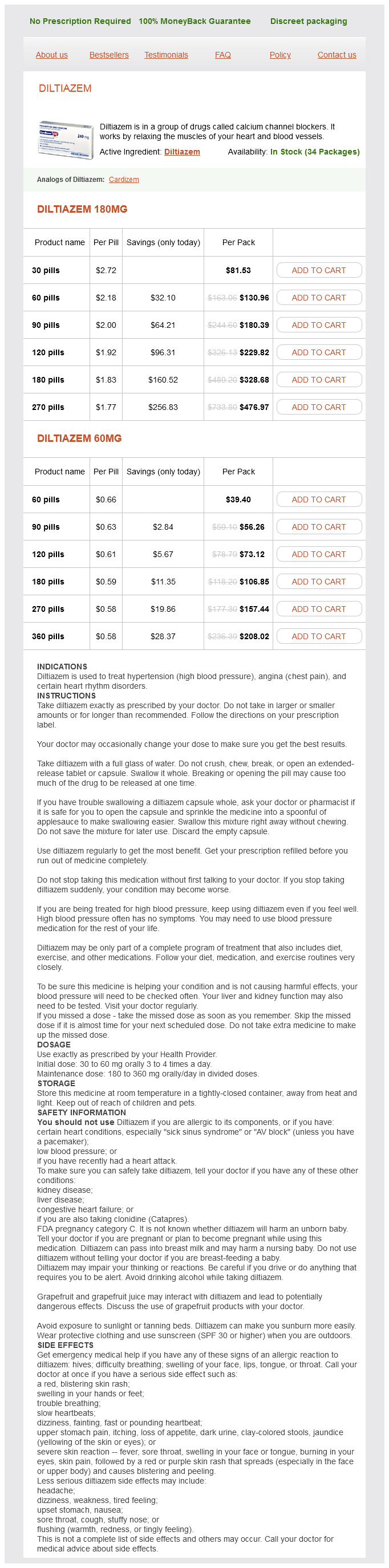
"Diltiazem 60 mg quality, medicine park lodging".
C. Zarkos, M.A., M.D., M.P.H.
Program Director, University of Iowa Roy J. and Lucille A. Carver College of Medicine
Diseases
- Milner Khallouf Gibson syndrome
- Vitamin E deficiency
- Tranebjaerg Svejgaard syndrome
- Microcephaly mesobrachyphalangy tracheoesophageal fistula syndrome
- Kowarski syndrome
- Chromosome 21, uniparental disomy of
- 6-pyruvoyltetrahydropterin synthase deficiency
- Stoll Geraudel Chauvin syndrome
- Diabetes insipidus, nephrogenic, recessive type
- Hydrocephalus endocardial fibroelastosis cataract
Place the affected person on respiratory isolation to prevent unfold of the organism to other transplant patients medications not to mix 60 mg diltiazem purchase otc. Clean the partitions treatment lichen sclerosis order 60 mg diltiazem visa, flooring medications you can give dogs diltiazem 60 mg order fast delivery, and ceilings of the patient rooms within the clinic and inpatient service with bleach to remove the supply of Pneumocystis medications like abilify order diltiazem 60 mg. Have the sufferers at risk for infection wash every day with a povidone-iodine antiseptic answer to decrease colonization with Pneumocystis. Begin prophylaxis with trimethoprim-sulfamethoxazole in all transplant sufferers for a minimum of 6 months, and longer for high-risk sufferers. Begin prophylaxis with clindamycin-pyrimethamine in all transplant sufferers for no less than four months, and longer for high-risk sufferers. Answer: D Outbreaks of Pneumocystis pneumonia have been reported from a number of renal transplant facilities over the previous 10 years. As demonstrated in molecular typing research, these outbreaks are caused by a single or a limited number of strains of Pneumocystis at every middle. This strongly implies latest transmission of the infection and potential acquisition as a nosocomial an infection. Current information recommend that Pneumocystis is acquired from other humans via transmission by the respiratory route. Infection could also be unfold during the incubation interval, which in animal models could be 8 to 12 weeks before the development of extreme pneumonia. Clindamycin-pyrimethamine has not been demonstrated to have exercise in either remedy or prophylaxis of Pneumocystis pneumonia. Trimethoprim-sulfamethoxazole is a highly efficient prophylactic regimen, and establishment of prophylaxis with trimethoprimsulfamethoxazole has been profitable in halting the outbreaks of Pneumocystis pneumonia reported to date. The patient famous that she had obtained trimethoprimsulfamethoxazole many years in the past for a urinary tract infection and mentioned she thought she developed a rash round her elbows but did complete her remedy. Begin dapsone, 100 mg/day, as a outcome of she could have an allergy to trimethoprim-sulfamethoxazole. Begin atovaquone, 1500 mg per day, as a end result of she might have an allergy to trimethoprim-sulfamethoxazole and sufferers with sulfa allergies are incessantly allergic to dapsone. Begin azithromycin, 1200 mg per week, to provide prophylaxis for each Pneumocystis and Mycobacterium avium complicated. Begin trimethoprim-sulfamethoxazole, one double-strength pill daily; change to dapsone if the patient develops a rash. Although she describes a potential rash during prior remedy with trimethoprim-sulfamethoxazole, a rash restricted to the elbows would be uncommon for a drug response, and reactions to sulfamethoxazole, the element that appears to be most commonly answerable for reactions to trimethoprimsulfamethoxazole, are not often instant or life-threatening. Dematiaceous fungal infections generally fall into three broad categories: mycetoma. The taxonomy of the dematiaceous fungi is considerably complicated as a result of these brokers belong to different classes, including Hyphomycetes, Ascomycetes, Basidiomycetes, Coelomycetes, and Zygomycetes. The most typical brokers of phaeohyphomycosis embrace species in the following genera: Alternaria, Bipolaris, Curvularia, Exophiala, Cladosporium, Cladophialophora, Fonsecaea, Exserohilum, Ochroconis, Phialophora, Phaeoacremonium, and Chaetomium. These agents are ubiquitous saprophytes of soil and decaying matter, and some are essential plant pathogens. In tissue, these organisms exist as yeastlike cells, septated hyphae, or a mix of yeast and hyphae. Most of those organisms demonstrate melanin pigmentation (brownish coloration) within the cell walls on microscopic examination. Most cases of chromomycosis are attributable to three species: Fonsecaea pedrosoi, Cladosporium carrionii, and Phialophora verrucosa. The distinctive histologic appearance is characterized by the presence of thick-walled, dark brown bodies often known as sclerotic cells or copper pennies, which represent particular person organisms and could also be seen in clusters or as single cells. The etiologic fungi inflicting chromomycosis are indistinguishable on histologic examination of tissue. Mycetoma is brought on by two teams of organisms: (1) the filamentous cardio actinomycetes (actinomycetoma) and (2) a wide range of saprophytic soil and woody plant fungi (eumycetoma). A related term, phaeohyphomycosis, refers broadly to infection by these pigmented fungi. These organisms trigger a variety of problems that change from benign circumstances such as onychomycosis, to extremely destructive and disfiguring mycetoma, to life-threatening, invasive phaeohyphomycosis in an immunocompromised particular person. Diagnosis is based on the id of attribute fungi on pathologic specimens and is confirmed by tradition. A combined medical/ surgical strategy might be greatest for these with mycetoma and intensive tissue involvement and for people with disseminated phaeohyphomycosis, particularly these with central nervous system involvement. Other causes of eumycetoma include some nondematiaceous fungi similar to Fusarium species, Acremonium species, Pseudallescheria boydii, and several other phaeohyphomycetes together with Exophiala and Curvularia species. Eumycetoma is additional characterized on the basis of the color of the granular drainage: white- to yellow-grain mycetomas (white piedra) are typically brought on by hyalohyphomycetes. Allergic fungal sinusitis related to dematiaceous fungi appears to be more common in the southern United States. Chronic infections of the decrease extremities are more commonly seen in men and in tropical areas. Chromomycosis are extra prevalent in rural populations in the tropics and are hyperendemic in certain geographic areas corresponding to Madagascar, India, Brazil, and different poorer international locations in Africa and South America. Cutaneous infections often occur on account of minor skin trauma and direct inoculation of the organism. Phaeohyphomycosis is a vital rising fungal an infection in medically superior regions, notably amongst immunocompromised sufferers similar to strong organ and hematopoietic stem cell transplant recipients, sufferers with prolonged neutropenia, and other immunocompromised individuals. Extracutaneous invasive disease also can occur in in any other case normal patients but is much much less widespread. The disorder is sort of prevalent in India, Latin America, the Middle East, and sub-Saharan Africa (the "mycetoma belt"). Moreover, the relative frequency of actinomycetoma and eumycetoma differs amongst geographic areas. Eumycetoma is more widespread in India and Africa, and actinomycetoma is more common in Central and South America. Furthermore, the causative agents of mycetoma differ of their geographic distribution. The disease is usually seen in rural areas and in persons vulnerable to local trauma and contamination from soil. Hence, farmers, gardeners, woodcutters, herders, and individuals who work outdoors whereas barefoot are more prone to this an infection. Chromomycosis is manifested as a cutaneous or subcutaneous lesion which will range in measurement from a small papule to a large confluent plaque involving a significant portion of an extremity. Lesions might stay unchanged in measurement and consistency for months or years, though most have a tendency to progress in the absence of particular therapy. Chronic lesions could turn out to be dry and crusted with a raised border, which can be easy or irregular, and which may tackle a verrucous, warty appearance. Multiple lesions can coalesce to form larger plaques during which central scarring may develop. Cutaneous lesions usually remain confined to one anatomic web site, although nodular lymphangitis and multifocal cutaneous disease from autoinoculation could happen. Black piedra is related to the development of focal thickening on the hair shaft and results from colonization of the shaft by Piedraia hortae. Cutaneous phaeohyphomycosis involves deeper pores and skin structures and leads to dermatomycosis and onychomycosis; that is frequently as a end result of agents similar to Scytalidium and Phyllosticta species. Patients have discrete subcutaneous nodules or cysts that end result from direct inoculation or penetrating trauma. The most common organisms are Exophiala jeanselmei, Exophiala dermatitidis, Alternaria alternans, and Phialophora species. Mycotic keratitis on account of infection with Curvularia, Exophiala, and Exserohilum species may happen after corneal trauma or surgical procedure. Foreign body�related infections are seen in sufferers present process chronic ambulatory peritoneal dialysis in whom fungal peritonitis develops, in sufferers with indwelling intravenous catheters, and in different units similar to breast implants. Fungal sinusitis13 is usually related to dematiaceous fungi and can be manifested as allergic fungal sinusitis, a fungus ball in a sinus cavity, and invasive fungal sinusitis related to extension into bone, delicate tissue, and the central nervous system. This final damaging process is indistinguishable from rhinocerebral zygomycosis or invasive Aspergillus sinusitis.
Gentianae radix (Gentian). Diltiazem.
- How does Gentian work?
- What is Gentian?
- Are there safety concerns?
- Dosing considerations for Gentian.
- What other names is Gentian known by?
- Symptoms of sinus infection (sinusitis) when combined with other herbs including elderflower, verbena, cowslip flower, and sorrel.
- Are there any interactions with medications?
- Is Gentian effective?
Source: http://www.rxlist.com/script/main/art.asp?articlekey=96701
This phenomenon happens in many individuals medicine abuse 60 mg diltiazem buy mastercard, often women symptoms xylene poisoning 180 mg diltiazem discount fast delivery, without any association with infection medications by mail generic diltiazem 60 mg without a prescription. Cardiac abnormalities are among the mostly reported extrapulmonary manifestations of M treatment tracker trusted diltiazem 60 mg. Signs and signs suggesting involvement of the guts are arrhythmia, congestive heart failure, chest ache, and electrocardiographic abnormalities, notably conduction defects. Although cardiac abnormalities have been reported in as many as 10% of instances of M. Central nervous system involvement is most typical in youngsters, with encephalitis the most common and most devastating. Cerebrospinal fluid findings in these instances are variable, but the mobile response is usually minimal, with barely elevated protein level and regular to barely depressed glucose concentration. Most often, the prognosis of Mycoplasma-related central nervous system involvement is based on the exclusion of different causes, the presence of an antecedent or intercurrent respiratory sickness, and an increase in antibody titer to M. On event, Mycoplasma-specific antibodies have been demonstrated in cerebrospinal fluid, however these titers have paralleled serum antibody titers. Neurologic complications are usually reversible; nonetheless, mortality in patients with central nervous system involvement is higher than in those with out such involvement. Polyarthralgias are common in Mycoplasma pneumonia, but monarticular or migratory arthritis is rare. Immune mechanisms have been postulated, but there have been a couple of stories of the isolation of M. Several of the cases of frank arthritis were reported in patients with hypogammaglobulinemia. Nonhuman mycoplasmas most likely cause arthropathy in several animal species, and Mycoplasma hominis has been associated with human arthritis. Rhabdomyolysis has additionally been increasingly reported and could also be associated with very excessive muscle enzyme, interleukin-18, and tumor necrosis factor- ranges. Renal problems related to immune complicated deposition and hightiter chilly agglutinins have been reported. Large pleural effusions and marked respiratory distress may develop in these patients. Functional asplenia and its attendant opsonization deficiencies may contribute to overwhelming infection with M. Children with immunodeficiency syndromes have been the subjects of case reviews of M. Because Mycoplasma infections are so widespread in normal youngsters, the contribution of immunodeficiency is unclear. Enzyme-linked immunoassays have been developed to detect IgM and IgG directed in opposition to M. When used in patients with optimistic assays for complement-fixing antibodies, the enzyme immunoassay had a specificity of greater than 99% and a sensitivity of 98%. Specificity was retained but sensitivity dropped to solely 46% when IgG alone was the target. The tests are simple to perform and have excessive sensitivity and specificity, however because all these checks are designed to detect IgM antibody, results could also be negative early in the center of an infection (<7 to 10 days). Sensitivity was also relatively high (91%) when the assay was used on sputum and nasopharyngeal aspirates from patients who have been shown by tradition or serologically to have M. Nonetheless, potential limitations around these diagnostics relate to their nonquantitative nature and the unclear significance of positive outcomes, which might happen in the context of colonization after acute infection has resolved. Future assays are more probably to utilize quantitative detection strategies, which should help to discern between colonization and infection. The pneumonia attributable to Mycoplasma is self-limited and never life-threatening in most cases. However, treatment with efficient antimicrobials may shorten the length of sickness and, by lowering cough and the variety of organisms per unit volume of sputum, could cut back the unfold of infection to contacts. Because Mycoplasma pneumonia is sporadic, many of the studies of antimicrobial efficacy are directed not at this single agent however somewhat on the therapy of community-acquired pneumonia (Chapter 91), of which Mycoplasma makes up a variable proportion. Some of these fulfill the desired role of antibody production- neutralization of the agent-and others appear to be autoantibodies. Agglutination was reversible by warming the serum-erythrocyte combination to 37� C and, unlike hemagglutination by myxoviruses and paramyxoviruses, was repeatable with the identical pattern, indicating that receptor-destroying enzyme (neuraminidase) plays no function in the dissociation at 37� C. Other illnesses that may give rise to chilly agglutinins are mononucleosis attributable to Epstein-Barr virus (anti-i), cytomegalovirus infection (anti-I), another viral diseases, and lymphoma. The sort of tube used to gather specimens for prothrombin determination is most popular. The blood is cooled to 4� C by placing it on liquid ice or in a regular refrigerator. The tube is then rewarmed to 37� C in an incubator or by publicity to body warmth and reexamined. The agglutination should dissociate at 37� C, and the appearance must be as it was earlier than cooling. This temperature-associated agglutination and dissociation can be repeated many times on the same pattern. A optimistic result within the bedside check correlates with a laboratory titer of 1: 64 or greater and is due to this fact much less delicate than the laboratory check. The presence of chilly agglutinins can also artifactually give rise to macrocytic indices secondary to in vitro clumping of erythrocytes, as measured by the Coulter counter technique. In this case, the pink cell distribution width would be excessive, indicative of heterogeneity in measured red cell measurement. Both exams have been standardized for testing on nasopharyngeal samples and have wonderful sensitivity and specificity when compared with serologic assays in the context of acute respiratory illness. Doxycycline is somewhat better tolerated than tetracycline and can be administered in two every day doses rather than three. Several different lessons of antimicrobials have important in vitro and in vivo activity against M. They are more active than the tetracyclines but are at least 100 instances much less lively than the macrolides. The streptogramins are additionally less active than the macrolides however extra energetic than the tetracyclines. There is a big cost differential in the usage of these drugs within the United States, even in generic type. Azithromycin is 5 to seven occasions dearer than erythromycin or doxycycline, and levofloxacin is 12 instances more expensive than erythromycin and 20 occasions the cost of doxycycline. During the past decade, there have been growing reports, first from Asia and later spreading to different areas including the United States,10 describing decreasing susceptibility of M. Taking all this under consideration, recommended remedy consists of doxycycline one hundred mg each 12 hours in older youngsters and adults, or azithromycin 500 mg on day 1 and then 250 mg every 24 hours. Young youngsters must be given azithromycin (10 to 12 mg/kg on day 1, followed by 5 mg/kg/day). A1 Given its longer half-life, 10 days of azithromycin must be enough therapy. Recently, the American Academy of Pediatrics has sanctioned short course of doxycycline in kids less than eight years of age, making doxycline an acceptable different for youthful youngsters. The ordinary duration of doxycycline therapy is 14 days; shorter courses might result in relapse. Their true incidence and prevalence are uncertain, as is their public well being impact. The genital mycoplasmas connect to cells using an adhesion protein in addition to lipid-associated membrane proteins that adhere by way of toll-like receptors. Diseases attributed to Ureaplasma species embody urinary tract an infection with and with out calculus formation. Some commercially available exams can detect several mycoplasmas and chlamydial organisms in a single panel, and the refinement and standardization of those exams should lead to extra readability of the pathogenic position of these organisms. The ensuing vaccines induced particular antibody responses, but protection was limited to not more than 50% of vaccine recipients.
Syndromes
- Excessive perspiration
- Endoscopy of the nose
- Swelling of the face, eyes, or tongue
- Blood thinners (anticoagulants) to help prevent blood clots in people with atrial fibrillation
- High serum osmolality
- Burns (widespread)
- Egg yolk
- Run tap water for a minute before drinking or cooking with it.
- Wakes you up from sleep
- Cartilage and meniscus injuries