
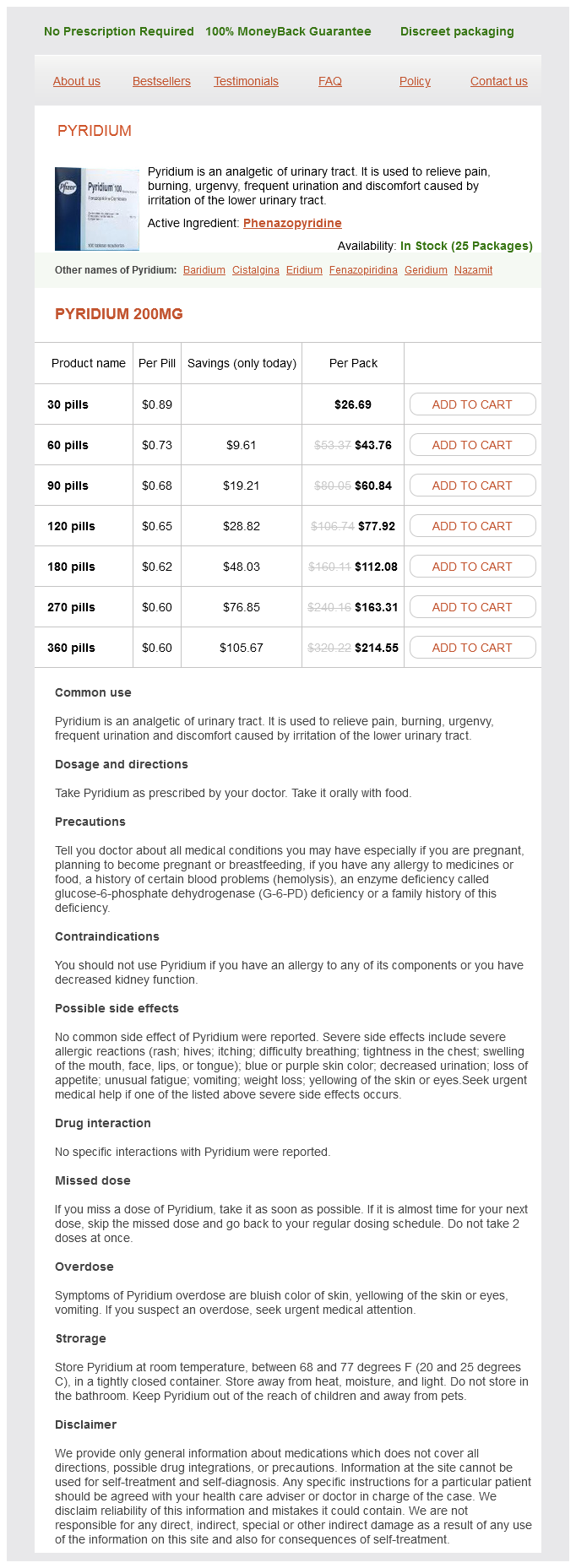
"Pyridium 200 mg generic on line, gastritis diet 0 cd".
V. Sinikar, M.B.A., M.B.B.S., M.H.S.
Clinical Director, Creighton University School of Medicine
Diseases
- Mitochondrial myopathy-encephalopathy-lactic acidosis
- DiGeorge syndrome
- Perniola Krajewska Carnevale syndrome
- Infant respiratory distress syndrome
- Cortical hyperostosis syndactyly
- Dysplasia
- Variegate porphyria
Another examine reported that a multilayered sonographic sample indicated a profitable abortion (Tzeng gastritis quiz buy pyridium 200 mg fast delivery, 2013) gastritis diet zucchini buy pyridium 200 mg lowest price. Compared with preprocedural levels mild gastritis symptoms treatment generic pyridium 200 mg line, Barnhart and coworkers (2004b) found declines of 88 % at day three and eighty two % at day eight following misoprostol administration correlated with a 95-percent fee of profitable abortion completion gastritis diet ÿíäåê purchase pyridium 200 mg amex. But, in the second trimester, dilation and evacuation (D & E) somewhat than suction D & C is dictated because of fetal dimension and bony construction. Of options, D & E is a common technique of second-trimester induced abortion in the United States. Of legally obtained abortions in 2013, 9 % have been carried out by D & E at gestational ages >13 weeks (Jatlaoui, 2016). Many of the surgical and medical steps for second-trimester abortion mirror those within the first trimester, and differences are emphasised here. Dilation and Evacuation Preparation With D & E, extensive mechanical cervical dilation precedes evacuation of fetal elements. The diploma needed rises with fetal gestational age, and insufficient dilatation risks cervical trauma, uterine perforation, or tissue retention (Peterson, 1983). Thus, presurgical cervical preparation is advised, and primary choices embrace hygroscopic dilators or misoprostol. With laminaria, in a single day preparation provides optimum cervical dilation (Fox, 2014). Uncommonly, laminaria might fail to adequately dilate the cervix, and serial laminaria insertion with an growing number of tents over a quantity of days is one option (Stubblefield, 1982). Supplementing laminaria with misoprostol or mifepristone is one other alternative (Ben-Ami, 2015). It may be preferable for same-day procedures as this gadget achieves its maximal effect in 4 to 6 hours (Newmann, 2014). The typical dose is 400 g given vaginally or buccally 3 to four hours previous to D & E. Randomized trials differ relating to the ability of misoprostol to achieve outcomes equal to that with hydroscopic dilators (Bartz, 2013; Goldberg, 2005; Sagiv, 2015). Misoprostol added to laminaria provides small increases in dilation but additionally higher side effects (Edelman, 2006). In one, mifepristone alone offered less dilation than hydroscopic dilators (Borgatta, 2012). In one other trial, mifepristone added 48 hours before misoprostol created higher cervical dilation in contrast with misoprostol alone (Carbonell, 2007). Last, Goldberg and associates (2015) compared hygroscopic dilation with or without added mifepristone. They found no variations for gestations <19 weeks, but the combination aided procedures for later ages. In sum, hygroscopic dilators are persistently effective for cervical preparation before D & E. For these desiring same-day procedures, Dilapan-S alone or misoprostol alone may supply advantages. Layering agents could additionally be most useful for later gestations or for an inadequate response from initial hygroscopic dilators alone. With elective abortion, some choose to induce fetal demise previous to D & E to avert a stay start or to avoid violating the Partial Birth Abortion Ban Act, cited later (Diedrich, 2010). For this, an intracardiac potassium chloride injection or a 1mg intraamnionic or intrafetal digoxin injection is incessantly used prior to cervical ripening (Sfakianaki, 2014; White, 2016). Technique During D & E, sonography can be utilized as an adjunct in all cases or selectively in more challenging ones. Perioperative antibiotic prophylaxis mirrors that for firsttrimester procedures (p. To reduce postprocedure bleeding, vasopressin, 2 to four items in 20 mL of saline or anesthetic, could be injected intracervically or as part of a paracervical block (Kerns, 2013; Schulz, 1985). Once sufficient cervical dilation is achieved, the preliminary surgical step drains amnionic fluid with an 11- to 16-mm suction cannula or with amniotomy and gravity. This reduces the chance of amnionic fluid embolism and brings the fetus into the lower uterine segment for elimination (Owen, 2017; Prager, 2009). For pregnancies beyond 16 weeks, the fetus is extracted, often in elements, utilizing Sopher forceps or other destructive devices. With full removal of the fetus, a large-bore vacuum curette is used to remove the placenta and remaining tissue. These include uterine perforation, cervical laceration, uterine bleeding, and postabortal infection. Rare problems embody disseminated intravascular coagulopathy or amnionic fluid embolism (Ray, 2004; York, 2012). Abnormal Placentation Placenta previa or the accrete syndromes can raise D & E risks. Once recognized, placenta accreta sometimes prompts hysterectomy (Matsuzaki, 2015). For placenta previa, D & E is preferred to rapidly evacuate the placenta, but the capacity to transfuse blood products and carry out attainable hysterectomy should be current (American College of Obstetricians and Gynecologists, 2017h; Perriera, 2017). Medical induction could additionally be elected, however the threat for transfusion is greater than with D & E (Nakayama, 2007; Ruano, 2004). Data are few, but predelivery uterine artery embolization might lower bleeding risks (Pei, 2017). If a medical agent is elected in these with prior cesarean hysterotomy, misoprostol is an option. Other Surgical Options Of these, dilation and extraction (D & X) is just like D & E besides that a suction cannula is used to evacuate the intracranial contents after delivery of the fetal body through the dilated cervix. This aids extraction and minimizes uterine or cervical damage from large instruments or fetal bones. In some women with second-trimester pregnancies who need sterilization, hysterotomy with tubal ligation is cheap. In some circumstances of a failed secondtrimester medical induction, either of these could additionally be thought-about. Medical Abortion Principal among noninvasive methods is a mifepristone plus misoprostol regimen or misoprostol alone (see Table 18-7). Of these two choices, the combined routine yields a shorter termination period (Kapp, 2007; Ngoc, 2011). Hygroscopic dilators could velocity the time to supply with this mixed regimen (Mazouni, 2009; Vincienne, 2017). In deciding on misoprostol routes, oral administration results in an extended time to delivery compared with vaginal or sublingual routes (Dickinson, 2014). Simultaneous administration of an antiemetic similar to metoclopramide (Reglan), an antipyretic such as acetaminophen, and an antidiarrheal similar to diphenoxylate/atropine (Lomotil) will help prevent or treat signs. However, its greater cost and poor pharmacologic stability at room temperature could make it much less enticing than misoprostol. Of other agents, high-dose intravenous oxytocin in saline will lead to secondtrimester abortion in eighty to 90 percent of instances (see Table 18-7). However, by comparability, misoprostol leads to larger profitable induction rates and sooner supply occasions (Alavi, 2013). Rarely used, ethacridine lactate is an organic antiseptic that activates myometrial mast cells to release prostaglandins (Olund, 1980). Fetal and Placental Evaluation For second-trimester gestations, D & E or medical induction is suitable clinically and psychologically. Thus, affected person input and medical indication information selection (Burgoine, 2005; Kerns, 2012). Once delivered, viewing and holding the fetus might or is most likely not desired by the patient (Sloan, 2008). One element is post-mortem, which can also be valuable for second-trimester losses or terminations because of anomaly. For instance, in a study of 486 ladies of all ages with second-trimester miscarriage, fetal malformations were recognized in 13 % (Joo, 2009). In one other, a 3rd of otherwise normal fetuses had associated chorioamnionitis that was judged to have preceded labor (Allanson, 2010). Indeed, according to Srinivas and associates (2008), ninety five percent of placentas in midtrimester miscarriages are irregular.
D-Alpha Tocotrienol (Vitamin E). Pyridium.
- Improving physical performance and strength in the elderly.
- Preventing dementia in old age.
- High blood pressure.
- Helping to treat kidney problems in children (glomerulosclerosis).
- Chest pain (angina).
- Helping the eyes heal after surgery.
Source: http://www.rxlist.com/script/main/art.asp?articlekey=96917
Am J Obstet Gynecol a hundred and five:949 gastritis symptoms for dogs buy pyridium 200 mg on line, 1969 Resnik R: Electronic fetal monitoring: the talk goes on gastritis yahoo answers 200 mg pyridium overnight delivery. Obstet Gynecol ninety six:571 gastritis symptoms months 200 mg pyridium otc, 2000 Rocha E gastritis symptoms in hindi discount 200 mg pyridium mastercard, Hammond R, Richardson B: Necrotic cell damage in the preterm and near-term ovine fetal brain after intermittent umbilical twine occlusion. Detailed appraisal of British and American classifications of fetal heart price decelerations-fallacies of emphasis on waveform and putative aetiology. Obstet Gynecol 97:454, 2001 Wiberg-Itzel E, Lipponer C, Norman M, et al: Determination of pH or lactate in fetal scalp blood in management of intrapartum fetal misery: randomised managed multicenter trial. Simpson, the discoverer of chloroform, for the introduction of anaesthesia into obstetrical follow. Whitridge Williams (1903) As cited by Williams, anesthetic strategies were a most welcome addition to obstetrics. Labor begins without warning, and anesthesia could also be required within minutes of a full meal. Vomiting with potential aspiration of the gastric contents is a constant threat because of delayed gastric emptying during being pregnant. Disorders of pregnancy corresponding to preeclampsia, placental abruption, or sepsis further compound provision of obstetrical anesthesia. Creanga and colleagues (2017) analyzed deaths of ladies during or within 1 yr of being pregnant in the United States from 2011 through 2013. As proven in Table 25-1, between 1979 and 2002, anesthesia-related maternal mortality charges decreased nearly 60 percent, and currently approximately five deaths per million stay births are attributed to anesthesia issues. Case-Fatality Rates and Rate Ratios of Anesthesia-Related Deaths During Cesarean Delivery by Type of Anesthesia within the United States, 1979�2002 About two thirds of deaths related to general anesthesia are attributable to intubation failure or induction issues throughout cesarean supply. Deaths related to regional analgesia are brought on by excessive spinal or epidural blocks- 26 %; respiratory failure-19 %; and drug reaction-19 p.c. The most important factor linked to lower maternal mortality rates is the greater use of regional analgesia (Hawkins, 2011). Logically, with increased use of regional analgesia, there at the second are reviews of complications with these methods. Indeed, compared to pre-1990 data, post-1990 obstetrical anesthesia was related to more authorized claims involving regional analgesia (Davies, 2009). In a recent analysis of 466,442 obstetrical hospital discharges, complications associated with regional analgesia accounted for 81 p.c of anesthesia-related opposed events (Guglielminotti, 2015). For the fetus, latest human research suggest that single, comparatively brief publicity to common anesthetic and sedation is unlikely to have adverse results on subsequent habits or learning. Listed drugs embody inhalation agents used in general anesthesia in addition to lorazepam, ketamine, propofol, and midazolam. Notably, the American College of Obstetricians and Gynecologists (2016a) and the Society for Obstetric Anesthesia and Perinatology (2017) have voiced considerations with this statement and cited the shortage of serious human information, particularly in pregnant women, to underpin this warning. Identification of any of the danger factors shown in Table 25-2 should immediate consultation with anesthesia personnel to permit a joint management plan. This plan ought to include methods to minimize the necessity for emergency anesthesia. Maternal Factors That May Prompt Anesthetic Consultation Body mass index >30 kg/m2 Short or thick neck or skeletal neck abnormality Obstructive lesions: edema, anatomical abnormalities, trauma Decreased range of motion in opening the mouth or small mandible Thyromegaly or different neck tumor Severe preeclampsia syndrome Bleeding problems Obstetrical complications with a high risk of operative delivery Maternal medical issues similar to cardiopulmonary illness Previous anesthetic problems Goals for optimizing obstetrical anesthesia providers have been established by the American College of Obstetricians and Gynecologists (2017a) and the American Society of Anesthesiologists (2016) and embrace: 1. Availability of anesthesia personnel to permit the beginning of a cesarean supply within half-hour of the choice to carry out the process. Anesthesia personnel immediately available to perform an emergency cesarean delivery in the course of the energetic labor of a girl attempting vaginal birth after cesarean (Chap. Appointment of a certified anesthesiologist to be answerable for all anesthetics administered. Availability of a certified physician with obstetrical privileges to carry out operative vaginal or cesarean delivery throughout administration of anesthesia. Availability of apparatus, services, and help personnel equal to that offered in any surgical suite. Immediate availability of personnel, other than the surgical staff, to assume duty for resuscitation of a depressed newborn (Chap. Providing such service in smaller facilities is more challenging-a problem underscored by the truth that approximately a 3rd of all hospitals offering obstetrical care perform fewer than 500 deliveries per yr. The financial burden incurred to present 24/7 obstetrical anesthesia coverage may result in cost deficits (Bell, 2000). Compounding this burden, some third-party payers have denied reimbursement for epidural analgesia in the absence of a particular medical indication-an approach repudiated by the American College of Obstetricians and Gynecologists (2017a). Regarding obstetricians, they should be proficient in native and pudendal analgesia. These may be administered in appropriately selected circumstances described on web page 489. Pain Relief Principles Hawkins (2010) emphasised that labor pain is a highly individual response to variable stimuli which may be uniquely acquired and interpreted. These stimuli are modified by emotional, motivational, cognitive, social, and cultural circumstances. Labor pain caused by uterine contractions and cervical dilation is transmitted by way of visceral afferent sympathetic nerves coming into the spinal wire from T10 by way of L1. Later in labor, perineal stretching transmits painful stimuli through the pudendal nerve and sacral nerves S2 through S4. Cortical responses to ache and anxiety throughout labor are advanced and may be influenced by maternal expectations for childbirth, her age, preparation by way of training, emotional help, and different elements. Pain perception is heightened by concern and the want to transfer into various positions. A woman may be motivated to have a sure kind of birthing expertise, and these opinions will affect her judgment regarding ache administration. Increases in cardiac output and vascular resistance may elevate maternal blood pressure. Pain, stress, and nervousness trigger launch of stress hormones such as cortisol and endorphins. The sympathetic nervous system response to pain leads to a marked elevation in circulating catecholamines that may adversely have an result on uterine exercise and uteroplacental blood circulate. If neuraxial analgesia is contraindicated or unavailable or is declined, a narcotic from Table 25-3 plus one of many tranquilizer-antiemetic drugs similar to promethazine (Phenergan) is often acceptable. With a profitable program of analgesia and sedation, the mom ideally rests quietly between contractions. In this circumstance, discomfort usually is felt at the acme of an effective uterine contraction. Some Parenteral Analgesic Agents for Labor Pain Parenteral Agents Meperidine and Promethazine Meperidine, 50 to one hundred mg, with promethazine, 25 mg, may be administered intramuscularly at intervals of 2 to four hours. A extra speedy effect is achieved by giving meperidine intravenously in doses of 25 to 50 mg each 1 to 2 hours. Whereas analgesia is maximal 30 to 45 minutes after an intramuscular injection, it develops virtually instantly following intravenous administration. Meperidine readily crosses the placenta and may have a chronic half-life within the newborn (American College of Obstetricians and Gynecologists, 2017a). Its depressant effect within the fetus follows carefully behind the height maternal analgesic effect. According to Bricker and Lavender (2002), meperidine is the commonest opioid used worldwide for ache reduction during labor. In one randomized study at Parkland Hospital, patient-controlled intravenous analgesia with meperidine was found to be an inexpensive and reasonably effective methodology for labor analgesia (Sharma, 1997). Women randomized to self-administered analgesia got a 50-mg meperidine plus 25-mg promethazine dose intravenously as an preliminary bolus. Thereafter, an infusion pump was set to ship 15 mg of meperidine every 10 minutes as wanted till supply. Neonatal sedation, as measured by the necessity for naloxone therapy in the supply room, was recognized in three % of newborns. Both meperidine and its metabolite, normeperidine, are lipophilic and readily cross the placenta. Analgesia with meperidine was associated with decrease Apgar scores compared to epidural analgesia (Sharma, 2004). Normeperidine is a strong respiratory depressant that has a considerably longer half-life than meperidine and is most likely going liable for the fetal side effects of meperidine.
Syndromes
- A CT or MRI scan if there is concern that the fracture was caused by a tumor or severe trauma (such as a fall or car accident)
- Difficulty breathing
- Inflammation of the pancreas (pancreatitis), which can be very serious
- At 36 months, does not have at least a 200-word vocabulary, is not asking for items by name, exactly repeats questions spoken by others, language has regressed (become worse), or is not using complete sentences
- Left-sided heart failure
- A curve in the penis during erection
- Bananas
- Sigmoidoscopy
- Edema (swelling under the surface of the skin)
- Radiation treatment: Women who had radiation therapy to treat cervical cancer have an increased risk of developing bladder cancer.