
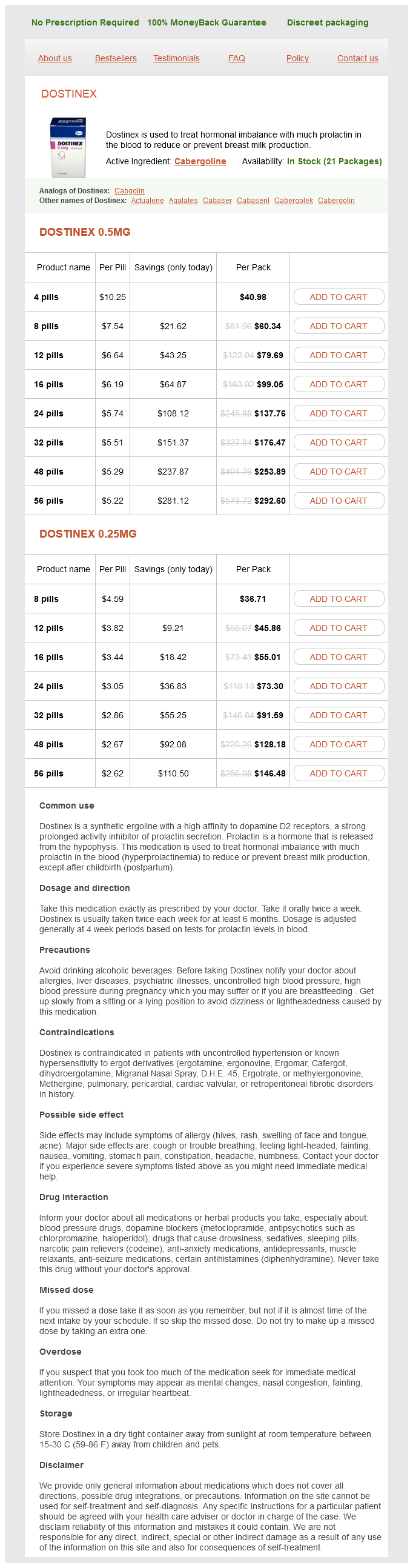
"Dostinex 0.5 mg buy otc, pregnancy x drugs".
A. Roland, M.B. B.CH. B.A.O., Ph.D.
Deputy Director, Chicago Medical School of Rosalind Franklin University of Medicine and Science
Diseases
- Congenital constricting band
- Physical urticaria
- Hypokalemia
- Diabetes insipidus, nephrogenic, recessive type
- Carnitine palmitoyltransferase I deficiency
- Urethral obstruction sequence
- Periodic disease
- Circumscribed cutaneous aplasia of the vertex
- Orofaciodigital syndrome type 2
Dexamethasone menstrual kotex order 0.25 mg dostinex fast delivery, a glucocorticoid women's health center jensen beach dostinex 0.5 mg discount with amex, suppresses pituitary corticotropin and thus adrenal androgen manufacturing breast cancer event ideas proven 0.25 mg dostinex, but this drug is used only in sufferers with elevated adrenal androgen manufacturing menstruation yeast infection generic 0.5 mg dostinex free shipping. Therefore, to confirm this prognosis, all different causes of these signs should be excluded. The best therapy choice for this younger girl is mixed hormonal contraceptive with spironolactone. It would also be good to maximize hair removal procedures to get rid of the hair she already has. Afflicted ladies report continuous lower stomach and pelvic pain that markedly hinders their every day actions. Although acute pelvic pain could additionally be related to life-threatening illness, persistent pelvic ache can also have a devastating impact on patients, and physicians ought to stay compassionate and empathetic. A the risk of major depression, sexual dysfunction, and substance abuse is increased. B the prevalence of childhood or adult sexual abuse is especially high, and the rate of marital and sexual dysfunction is larger among this cohort of sufferers. C Psychological counseling and testing may be essential to determine sufferers who require extra extensive remedy. A Neuroanatomy the pelvic organs receive their innervation from the autonomic nervous system, which is composed of each sympathetic and parasympathetic fibers. Sympathetic nerves are used to transmit most afferent stimuli through cell bodies that lie in the thoracolumbar distribution. Impulses from the uterus journey via the uterosacral ligaments to the uterine inferior plexus. The ovaries and distal fallopian tubes derive their nerve supply independently and enter the spinal twine at T9 and T10. Parasympathetic nerve fibers are also concerned to a lesser extent within the transition of painful stimuli. Impulses from the higher vagina, cervix, and lower uterine segment journey through the parasympathetic system to the sacral roots S2 to S4. Both sympathetic and parasympathetic fibers innervate the bladder, rectum, perineum, and anus, which are derived from the urogenital sinus. Fibers from the perineum and anus mix to type branches of the pudendal nerve, finally terminating within the second and fourth sacral root. Splanchnic ache occurs when an irritable stimulus is appreciated in a specific organ secondary to pressure (stretching, distention, or pulling), peritoneal irritation or inflammation, hypoxia or necrosis of viscera, or production of prostanoids. Referred pain happens when autonomic impulses come up from a diseased visceral organ, eliciting an irritable response inside the spinal wire. It is paramount to exclude the chance of an ectopic tubal gestation, a life-threatening condition. Pelvic ache happens on account of distention of the fallopian tube caused by the growing pregnancy. If the being pregnant ruptures via the fallopian tube, rebound tenderness may happen. Shoulder pain could develop as a outcome of blood in the abdomen causing diaphragmatic irritation and stimulating the phrenic nerves. A pregnancy take a look at is remitted in any woman of childbearing age who presents with acute pelvic pain. If the take a look at is constructive, the presence of an ectopic pregnancy have to be excluded from the differential prognosis, particularly in patients with irregular uterine bleeding. Midcycle pain or mittelschmerz is ache within the decrease abdomen noticed at or close to the time of ovulation. It is believed to be secondary to chemical irritation of the peritoneum from ovarian follicular cyst fluid after ovulation. The use of ultrasonic visualization of the ovaries most frequently confirms or excludes this analysis. The clinical presentation is usually a historical past of sudden onset of ache accompanied by nausea and vomiting. The pain is often paroxysmal and unilateral however turns into more fixed if infarction occurs. Diagnosis is made on scientific presentation, and laparoscopy have to be carried out to affirm the diagnosis. Rebound tenderness and a partial ileus may result from the presence of purulent materials within the pelvic and belly cavity. Secondary dysmenorrhea is brought on by a defined pelvic abnormality, similar to endometriosis or m�llerian anomaly. It is usually situated diffusely within the lower stomach and should radiate to the lower back and legs. The etiology of painful uterine contractions includes prostaglandin F2 produced within the endometrial cells by the motion of phospholipase A2 on lipid cell membranes, forming arachidonic acid. Associated symptoms embrace backache, nausea, vomiting, diarrhea, headache, and fatigue. Endometriosis is characterised by the presence of endometrial glands and stroma exterior the uterine cavity (see Chapter 27). The mechanism of pain from endometriosis is hypothesized to be cyclic focal bleeding from peritoneal implants, the inflammatory cytokines released from an elevated variety of peritoneal immune cells, and from irritation or infiltration of the pelvic ground nerves. Theories include retrograde menstruation, metastases through vascular and lymphatic channels, altered immune response to ectopic endometrial tissue, and metaplastic transformation of totipotential cells. Approximately 25% to 40% of patients who endure laparoscopy for continual pelvic pain have evidence of endometriosis. Adenomyosis, a condition characterised by the presence of ectopic foci of endometrium inside the myometrium, may also trigger continual pelvic ache and extreme dysmenorrheal and can be related to menorrhagia. Hydrosalpinges can become reinfected inflicting important ache, fever, and infrequently sepsis and dying. Initial an infection that damages the fallopian tubes could also be asymptomatic, for example Chlamydia, so an acute presentation could not precede the persistent sequellae. Due to extensive an infection and inflammation, surgical therapy will typically necessitate removal of each ovaries, fallopian tubes, and even the uterus and due to this fact should be thought-about carefully in a younger reproductive age woman. Functional cysts may be managed expectantly as they should resolve; nevertheless, tumors are treated surgically. M�llerian anomalies may end in an obstructed outflow tract related to pelvic ache (see Chapter 21). A partial obstruction of a part of the m�llerian buildings that permits common menstruation. This category would come with situations such as a noncommunicating obstructed uterine horn, an obstructed hemi-vagina related to a duplicated cervix and uterine didelphys, and septate or bicornuate uterine fundus. Mechanisms embody: fibroid degeneration inflicting pain, dysmenorrhea because of passage of enormous blood clots associated with menorrhagia, and cramping associated with passage of enormous intracavitary fibroid by way of the cervix. Pressure symptoms, constipation and urinary frequency can occur relying on the scale and site of the fibroids. It has an estimated prevalence of 5 instances per 1,000, with ladies affected 10 instances greater than men. Other incessantly noticed symptoms embrace dyspareunia, premenstrual flare of symptoms, and generalized pelvic pain. Other urologic situations that may result in lower belly pelvic pain include urethral syndromes, bladder malignancy, acute or persistent urinary tract infections, and renal lithiasis. Appendicitis: the ache is initially not properly localized as a end result of it outcomes from luminal distention of the appendix by inflammatory exudates. However, the ache finally localizes to the best lower quadrant when the parietal peritoneum turns into regionally concerned in the inflammatory course of. Patients current with relapsing and remitting abdominopelvic pain related to bloating and bowel dysfunction (diarrhea, constipation, or both). Associated options embody abnormal stool frequency (more than 3/d or fewer than 3/wk), or 25% of bowel actions affected by irregular stool kind, abnormal stool passage, passage of mucus, or emotions of bloating or distension. Other gastrointestinal causes of chronic pelvic ache embody constipation, inflammatory bowel illness, and carcinoma of the colon. E Musculoskeletal problems Pain is most commonly because of repetitive stress and pressure related to the standard pelvic pain posture, increased lumbar lourdosis and anterior tilt of the pelvis. This posture permits weak and deconditioned muscles to kind an imbalance within the pelvis resulting in formation of trigger point, hypertonicity, and elevated pelvic ache. Other musculoskeletal causes embrace myofascial pain syndromes, fibromyalgia, compression of decrease vertebrae, and persistent again ache.
Adrenal Polypeptide Fractions (Adrenal Extract). Dostinex.
- Dosing considerations for Adrenal Extract.
- Are there safety concerns?
- How does Adrenal Extract work?
- What is Adrenal Extract?
- Low adrenal function, fatigue, stress, fighting off illness, allergies, asthma, skin conditions such as eczema and psoriasis, rheumatoid arthritis, depression, low blood pressure, low blood sugar, drug and alcohol withdrawal, and other conditions.
Source: http://www.rxlist.com/script/main/art.asp?articlekey=96904
Ultrasound demonstrates a cephalic fetus menstrual wipes generic dostinex 0.5 mg free shipping, placenta is fundal and freed from the os without a retroplacental clot women's health rochester ny dostinex 0.25 mg purchase overnight delivery. A Betamethasone and magnesium for tocolysis with maternal transfusion as needed B Augmentation of labor with amniotomy and pitocin C Immediate cesarean delivery with appropriate maternal and fetal resuscitation D Betamethasone and indocin for tocolysis E Intravenous fluid resussitation and ephedrine four mensis purchase dostinex 0.25 mg on-line. A 34-year-old woman menstrual history dostinex 0.5 mg visa, gravida 5, para 4004, at 30 and 2/7th weeks of gestation presents to labor and supply reporting vaginal bleeding. Fetal monitoring reveals one uterine contraction each half-hour, and the fetal coronary heart price is reassuring. A 32-year-old woman, gravida 5, para 2022, at 36 weeks of gestation with placenta previa presents to labor and supply with vaginal bleeding. The affected person is at risk for the entire following besides: A Consumptive coagulopathy B Sheehan syndrome C Acute tubular necrosis D Couvelaire uterus E Emergent hysterectomy 98 Chapter 9-Answers and Explanations Answers and Explanations 1. Her risk components for placental abruption embody a prior history of placental abruption, advanced maternal age, cocaine use, and hypertension. This patient presents with painless vaginal bleeding after intercourse, with no earlier ultrasound performed and sure has bleeding from an undiagnosed placenta previa. A transabdominal ultrasound will be the most helpful take a look at to affirm this prognosis. A digital examination could be contraindicated till placental localization was determined. This medical state of affairs is consistent with an initial bleed within the setting of placental previa. Expectant management is justifiable if the fetus is preterm (less than 37 weeks) and might benefit from further intrauterine development. Betamethasone is indicated given the risk of preterm supply in sufferers with placenta previa difficult by vaginal bleeding. The affected person may be discharged after the bleeding lessens and the physician judges that the fetus is healthy. Couvelaire uterus finding is famous within the setting of placenta abruption when blood has extravasated in to them myometrium. A Oxytocin stimulation Endogenously produced oxytocin, which causes uterine contractions, could play a role in the spontaneous onset of labor. The elevated number of oxytocin receptors amplifies the biologic effect of oxytocin, and contractions intensify. B Fetal cortisol levels Fetal cortisol ranges may affect the spontaneous onset of labor. Disruption of hypothalamic�pituitary�adrenal axis or the absence of adrenal gland or perform leads to extended gestation in people and sheep. However, in humans, there was no documentation of prelabor surge in fetal cortisol secretion to completely help this concept. In rabbits, the withdrawal of progesterone is adopted by the prompt evacuation of the contents of the pregnant uterus. However, the progesterone stage on the placental site could decrease before the onset of labor. This decrease in progesterone, in association with increased estrogen ranges, is adopted by elevated formation of gap junctions, which enable coupling of the myometrial cells. The normal processes of labor appear to lead to irritation, which results in elevated prostaglandin synthesis. Prostaglandins produced in myometrial tissue might contribute to the effectiveness of myometrial contractions throughout labor, and may soften the cervix unbiased of uterine exercise. It begins when uterine contractions turn into sufficiently strong or sufficient to provoke effacement and dilation of the cervix. Effacement of the cervix is the shortening of the cervical canal in to a paper-thin oriface. Effacement occurs as the muscle fibers near the inner os are pulled upward in to the lower uterine segment. For the head of the typical fetus at time period to have the flexibility to pass via the cervix, the cervix should dilate to a diameter of approximately 10 cm. When the fetal head is in a position to descend past the remaining cervix, the cervix is not palpable and is said to be utterly or absolutely dilated. The second stage of labor involves the passage of the fetus via the maternal pelvis and expulsion of the fetus. It begins with the complete dilation of the cervix and ends when the toddler is delivered. In a nulliparous patient, the second stage of labor ought to final lower than 2 hours without regional anesthesia, and less than three hours if a woman has regional anesthesia. In a multiparous patient, the second stage of labor ought to last less than 1 hour without regional anesthesia, and less than 2 hours if a lady has regional anesthesia. It begins with the delivery of the toddler and ends with the delivery of the placenta. As uterine contractions involve increasing numbers of myometrial fibers, the depth and period of the contractions increase. In early labor, the contractions happen every 5 to 10 minutes, final for 30 to forty five seconds, and are 20 to 30 mm Hg in intensity. As labor progresses, the contractions occur every 2 to 3 minutes, last for 50 to 70 seconds with forty to 60 mm Hg in pressure/intensity. The myometrial fibers of the upper portion of the uterus shorten, and therefore the wall of the upper uterus thickens. As a result of labor the decrease uterine phase thins out, the cervix is "taken up" in to this section, and is ultimately pulled over the fetal presenting part. The type of cephalic presentation depends on the degree of flexion or extension of the fetal head. A wide pubic arch, straight sidewalls, curved sacrum and never prominent ischial spines, facilitate passage of a fetus. The pubic arch is slim, the sidewalls are convergent, the sacrum is anteriorly inclined, and the ischial spines are prominent, all of which are more obstructive to fetal passage. Anthropoid-diameter is long from front to back and relatively narrow from aspect to aspect. The occiput could present in transverse, anterior, or posterior and proper or left position. A means of positional adaptation of the fetal head to the various segments of the pelvis is required to full childbirth. These positional modifications occur sequentially in the following order: engagement, descent, flexion, internal rotation, extension, external rotation, and expulsion. The biparietal diameter of the fetal head, the greatest transverse diameter of the head in occiput presentations, passes through the pelvic inlet. When engagement happens, the lowest level of the presenting half is, by definition, on the stage of the ischial spines, which is designated as 0 station. Levels 1, 2, and 3 cm above the spines are designated as 1, 2, and 3 stations, respectively; ranges 1, 2, and 3 cm under the spines are designated as 1, 2, and three stations, respectively. Engagement might happen throughout the earlier couple of weeks of being pregnant, or it may not happen until labor begins. In multigravid girls, the fetal head is much less more probably to be engaged at the onset of labor, and the fetal head is floating or freely movable above the pelvic inlet. In primigravidas, whereas engagement could happen before the onset of labor, additional descent could not follow until the onset of the second stage. When the descending head meets resistance from either delicate or bony tissue in the pelvis, flexion of the fetal head usually happens. This motion causes a smaller diameter of fetal head (biparietal diameter) to be offered to the pelvis, instead of the longer occipitofrontal diameters. This motion includes the gradual turning of the occiput anteriorly, such that the sagittal suture runs anteroposteriorly because the fetal vertex descends through the airplane of the midpelvis. When the sharply flexed fetal head meets the vulva, the occiput is introduced in direct contact with the inferior margin of the symphysis. Because the vulvar outlet is directed upward and ahead, extension must occur for the pinnacle to move through. In this movement, the occiput returns to the oblique place from which it started and then to the transverse position, left or proper. This motion corresponds to the rotation of the fetal physique, bringing the shoulders in to an anteroposterior diameter with the pelvic outlet.
Syndromes
- Soaps or lotions containing coal tar
- Irritable bladder
- You have a fever that lasts for more than 2 or 3 days, or a fever higher than 100.4°F without an illness
- Does the person use alcohol? How much?
- Nerve damage during surgery
- Antibody testing