
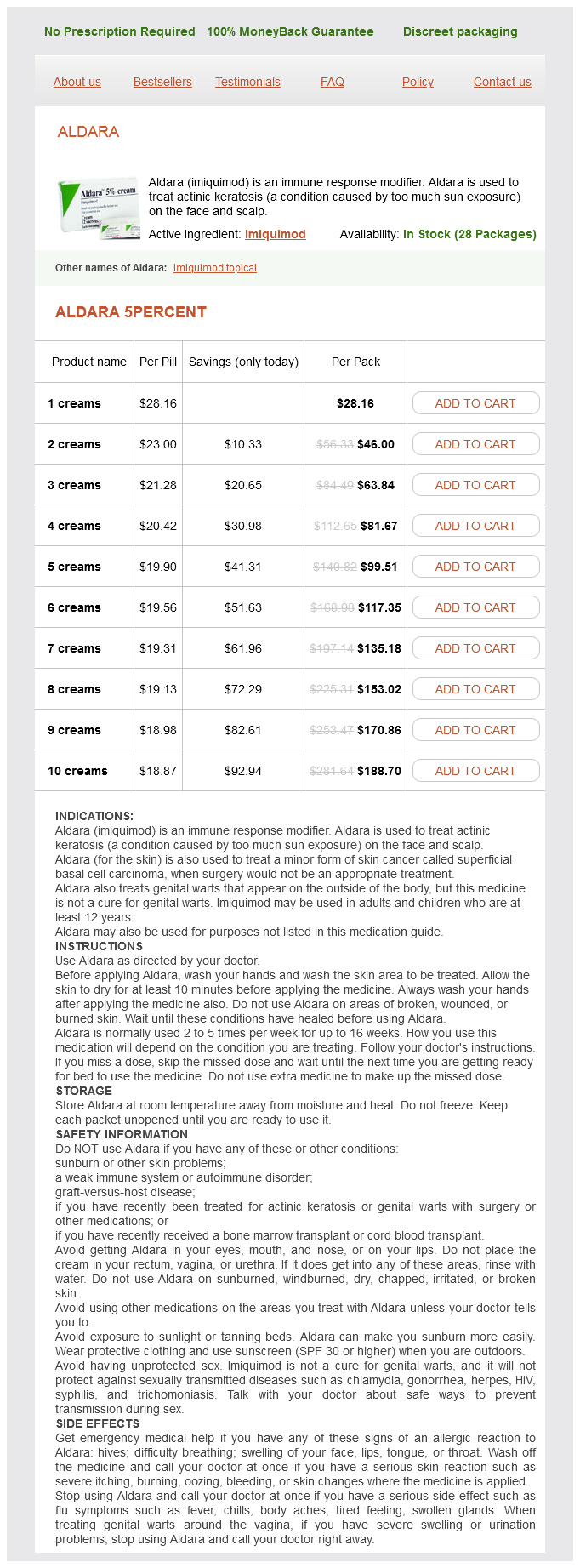
"Aldara 5 percent generic with visa, skin care jakarta selatan".
U. Khabir, M.B. B.CH. B.A.O., M.B.B.Ch., Ph.D.
Clinical Director, University of Kentucky College of Medicine
Monozygous twinning may happen in an irregular conception simply as in a normal one acne whiteheads 5 percent aldara safe, and the occasional occasion of twins concordant for an abnormal karyotype is to be expected (Schlessel et al skin care chanel aldara 5 percent buy on line. Rather extra outstanding is the case of monozygous twins discordant for karyotype- clearly skin care untuk jerawat aldara 5 percent order with mastercard, the adjective "similar" is inappropriate here! A variety of similar circumstances are on report skin care home remedies aldara 5 percent order with visa, including monozygous twins of opposite gender (Lewi et al. Perhaps essentially the most extraordinary circumstance of discordance in monozygous twins issues the acardiac (that is, missing a heart) fetus. An initially normal conceptus would possibly generate a trisomy 2 cell line that then separates and produces the cotwin, or an initially trisomic conceptus offers rise to a "corrected" lineage. It is only the presence of the conventional twin that allows the acardiac co-twin to survive, with placental vascular connections providing 14 For the record, the chimera of classical mythology was "in the forepart a lion, in the hinder a serpent, and in the midst a goat. The Origins and Consequences of Chromosome Pathology � forty three blood circulation from regular to irregular twin. These could also be very obvious on classical karyotyping or, for smaller deletions or duplications (3�5 Mb), may have required highresolution banding for identification. With molecular karyotyping, imbalances of submicroscopic measurement, sometimes measured in kilobases, are detectable (Gu et al. As noted above, "microdeletion" and "microduplication" are used here to describe these kilobase- or low Mb-size imbalances when clearly pathogenic, whereas "copy number variant" is the expression when pathogenicity is uncertain or virtually excluded. Jacobs (1981) derived the following mutation rates for the era of de novo classical rearrangements: 1. Concerning CnVs, the mutation rate for bigger (>500 kb) microdeletions/ duplications is 6. In other words, out of a hundred,000 gametes, 16 may have a balanced and 29 an unbalanced de novo classical rearrangement, while 650 could have a de novo larger CnV. The illegitimate breakage and reunion that produces these rearrangements is usually because of the apposition of nonmatching (nonhomologous) chromosomal segments, however which do occur to comprise DnA sequences with a high diploma of homology ("low copy repeats"). Most breakpoints are in nontranscribed DnA, and thus, for probably the most half, contribute no untoward impact per se upon the phenotype. We focus on possible mechanisms of formation in more detail in the acceptable chapters. Setting in Which De Novo Rearrangement Occurs While mutations causing chromosomal rearrangement could, in principle, occur throughout both meiosis or mitosis, and within the gonad of either intercourse, actually, different chromosomal varieties differ in this respect. Most Robertsonian translocations arise in o�genesis, at a maternal meiosis (Bandyopadhyay et al. Microdeletions/duplications can occur in both gonadal types, and largely at a meiosis, at least inasmuch as the common cases of 7q11, 15q11q13, and 22q11 could additionally be considered to be consultant (Thomas et al. On the opposite hand, spermatogenesis is the setting for almost all de novo nonRobertsonian reciprocal rearrangements, and each meiosis and premeiotic mitoses may be the website (H�ckner et al. Balanced, Apparently Balanced, and Unbalanced Rearrangements Structural rearrangements may be balanced, with the right quantity of genetic materials in a cell, or unbalanced, with a deletion and/or duplication of genetic materials. In some, the scientific picture, in mild of information of the chromosomal breakpoints, may inform interpretation. The classical cytogenetic study showed them to be heterozygotes for the apparently balanced translocation t(16;17)(q12;p11. This disruption would have led to a functional haploinsufficiency, which is known to be the idea of pressure-sensitive neuropathy. Molecular karyotyping may forged gentle on previously ill-understood photos and, for example, reveal a submicroscopic microdeletion/duplication (Feenstra et al. The more irregular the phenotype, the larger the likelihood of detecting imbalance. The extraordinary sophistication of complete genome sequencing might supply but additional precision of interpretation (Ordulu et al. They recognized disruptions in five genes located at one or both breakpoints, of very believable role within the scientific phenotypes. The determinations had been at the nucleotide degree of precision; for instance, in the apparently balanced t(9;17) (q12;q24), seen in a father and his two youngsters with poor speech development, the rearrangement had truly generated deletions at chr9:seventy seven,767,26577,767,269 and chr17:seventy nine,257,250-79,260,287. In such a population, during which the fraction is less than one hundred pc, we might speak of incomplete penetrance; in a single individual showing no abnormality, that is nonpenetrance. Expressivity is qualitative, and displays the vary of clinical manifestation, in these in whom a situation has been penetrant. It may typically become a matter of semantics whether or not a subtly irregular person is considered to represent nonpenetrance or penetrance with very gentle expressivity. The Origins and Consequences of Chromosome Pathology � 45 the molecular-defined microdeletions/duplications is different. Some carriers might show no clinical abnormality, and but a baby of theirs may have introduced with obvious symptomatology. These regular mother and father are thought of to be nonpenetrant with respect to the imbalance in query. It is extra significantly with autism and nondysmorphic intellectual disability that these issues apply. The basis of this variation may lie within the coexistence of one other microdeletion/duplication or CnV, more than likely on another chromosome, and inherited quite coincidentally. It may be extra correct to speak of two hits "multiplying collectively," rather than "including up," to produce a phenotype of combined impact. These penetrance data are listed within the applicable entries in Chapter 14 and in toto in Table 4�1. As extra knowledge are collected, we may anticipate a better understanding of the character of the putative secondhit imbalances. The expression "genomic imprinting" is applied in the setting of epigenetic effects that are imposed during germline transmission. When the phenomenon was first appreciated in humans, it was naturally suspected that many forms of congenital abnormality could be as a outcome of aberrant imprinting. As it has transpired, nevertheless, the practical software of genomic imprinting seems to be confined to a quite small number of cytogenetic circumstances. That is, with every locus having a pair of alleles, each of the pair is functionally energetic, contributing roughly equally to the genetic output from that locus. A minority of the genome is subject to imprinting and requires solely one of many pair of alleles to be active, whereas the opposite one turns into inactivated ("silent"); in other phrases, the locus is functionally monosomic, with a genetic output from just one allele. If the 18 A rare and completely different type of two-hit mechanism considerations the "unmasking" of a recessive allele on a traditional homolog, because of a deletion of that segment on the opposite chromosome (Poot 2012; Paciorkowski et al. Following conception, the imprint stays by way of cycles of postconceptional somatic mitoses: the chromosome "remembers" the intercourse of the father or mother who contributed it (put in a unique way, it retains its epigenetic mark). The imprinting sample could additionally be specific to a certain tissue or to a certain developmental stage (Ideraabdullah et al. Thus, in some tissues a gene may specific monoallelically, whereas in other tissues biallelic expression is retained; or a gene could express monoallelically in a specific tissue at one stage in embryogenesis and biallelically thereafter. It is mediated by way of a process going down during gametogenesis, of which the physical basis contains methylation of cytosine bases inside the gene(s), or in controlling sequences upstream of it. Another class of epigenetic effect is that imposed by compromise of controller elements, such that the client gene, which is of itself regular, is inappropriately nonfunctioning or overfunctioning. This may reflect a "position effect" due to a translocation separating the controller and the consumer, as mentioned above. The imbalance includes an entire chromosome (full aneuploidy) or a half of a chromosome. From classical cytogenetics, the latter state is described as partial or segmental aneuploidy, a deletion or a duplication. In molecular karyotyping, during which the main focus is on a lot smaller segments, the terms used are microdeletion and microduplication. An incorrect quantity of dosage-sensitive genetic materials in every cell of the conceptus distorts its growth to a larger or lesser extent. Large losses or positive aspects nearly invariably set early anatomical development so awry that natural abortion happens. Lesser imbalances could also be appropriate with continued intrauterine survival, however with the eventual production of a phenotypically irregular youngster. However, as a primary principle, something but one hundred pc of the traditional quantity of genetic materials (in classical, megabase cytogenetic terms) produces a less than 100% regular phenotype. Mental defect is the simply about universal consequence of classical forty seven Mechanisms Whereby Functional Genetic Abnormality Can Arise In the context of imprinting, we may think about three categories of functional genetic defect. These are as follows: uniparental disomy with overexpression or nonexpression of genes in certain chromosomal segments; deletion with nonexpression; and relaxation of imprinting with overexpression.
Drachenkraut (Hemp Agrimony). Aldara.
- What is Hemp Agrimony?
- Dosing considerations for Hemp Agrimony.
- Liver and gallbladder disorders, colds, and fever.
- Are there any interactions with medications?
- Are there safety concerns?
- How does Hemp Agrimony work?
Source: http://www.rxlist.com/script/main/art.asp?articlekey=96497
The inac tivation of one of the two centromeres allows this chromosome to be mitotically functional acne infection aldara 5 percent order on line. Note also that the yp or yq desig nation refers to the site of breakpoint acne infection 5 percent aldara buy, and that the idic(y)(p) has two complete yq copies skin care 360 order 5 percent aldara free shipping, whereas vice versa acne xia effective aldara 5 percent, the idic(y)(q) has two complete copies of yp. Generation is de novo, usually in (obviously) 5 this could typically lead to muddling of nomenclature. Sex Chromosome Aneuploidy and Structural Rearrangement � 349 paternal gametogenesis, and reflecting a vulnera bility because of the apposition of similar y sequences; unusual cases may be due to a postzygotic event. Mosaicism very regularly accompanies as a postzygotic event, with forty five,X and a second abn(y) the usual extra cell lineages. Immature germ cells in the ejaculate were, total, of pretty similar fractions of haploid 23,X and 23,idic(y) karyotypes, indicating that the primary stage of meio sis, division of the primary spermatocyte, had been entered. The solely woman had a Turnerlike scientific picture, and about half of cells, on blood, have been 45,X; compared, in the series of beaulieu bergeron et al. Ambiguous genitalia with ovotesticular dSd/mixed gonadal dysgenesis was the presenting sign up three youngsters in Mekkawy et al. If the gonad is 45,X, a Turnerlike phenotype is seen; or, if the gonad comprises both 45,X and forty six,X,r(y) lineages, a blended gonadal dysgenesis, presumably with a genital ambiguity, may be the consequence (Milenkovic et al. A Turnerlike habitus, albeit in a male, could in any event come up, if the ring is very small and lacks any yq material (Tzancheva et al. In the ring y man, azo�spermia is usual, and fewer than 1% of circumstances have been inherited from a ring y father (Arnedo et al. In the ory, and since only the forty six,X,r(y) gametocytes are "meiotically competent" (blanco et al. There is a maturation arrest on the level of the primary spermatocyte, mirrored in the azo�spermia of this man. The restrict of viability for the hemizy gous deletion male is outlined by the instances studied in Melichar et al. The phenotype may be very abnormal and consists of severe psychomotor retarda tion, L�riWeill syndrome, chondrodysplasia punc tata, ichthyosis, Kallmann syndrome, and ocular albinism. As with the del(Xp), the risk of transmission is presumed to be 50:50, but the out come is dependent upon the gender of the child. She came to prenatal diagno sis and elected to terminate a male being pregnant with the deletion, the expected phenotype being extreme (Coman et al. Favorable inactivation, skewed toward the del(Xp), may see the normal X maintain sway (Morleo and Franco 2008). The mom was of short stature, and she or he had had one eye removed in infancy; the daughter was blind due to bilateral eye involvement, quick, dys morphic, had lost language capability, and developed indicators of autism. Thus, the danger to the female provider to have a residing affected baby is onethird, the segregation ratio of 1:1:1 applying to normal female:affected feminine:normal male. Intellectual defi cit could be extreme; one patient is described as "apha sic and incontinent. The deletion in the idic(y)(q) might contain a distal part of yq, in firm with dupli cation of proximal yq and all of yp, and vice versa within the idic(y)(p), with a partial distal del(yp) and dup(yq), as mentioned above and in Chapter 19. Autistic habits and epilepsy (or at least an abnormal electroencephalo graphic pattern) are recorded. In these, the inheritance sample might be described, in essence, as Xlinked dominant. Most instances, nevertheless, have been de novo, and in these, the irregular X has consistently been of paternal derivation. In feminine de novo instances, X inactivation, where measured, has been nonran dom, and markedly skewed towards the traditional X-a most exceptional observation (dibattista et al. Thus, the abnormal X is preferentially acti vated, and loci throughout the duplicated phase could express a functional, and therefore doubtlessly dam getting older, disomy. Some recurrent break points are noticed, sited at factors of long terminal repeats. The medical picture consists of intellectual deficiency, with a selected concentrate on poor speech acquisition. In one notable family, by which the duplication encom handed each Region 1 and Region 2, inheritance from grandmother to mom to male youngster was observed. One youngster had two affected male cous ins, these boys being the sons of three provider sis ters; one of many maternal grandparents was probably a mosaic hemizygote or heterozygote. The noticed phenotype in the affected male is one of intellectual deficiency and a spotlight deficit/hyperactivity. The 46,X,dup(X)(p21) feminine service is normal (seven carriers within the sixgeneration kindred in barbaro et al. In a few of these larger duplications, male gender may develop substantially usually; mild facial dysmorphism is also seen, as illustrated within the 12 Mb dup(X)(p21. She herself and her provider daughter have been of quick stature however normal intelligence. The affected males are microcephalic with marked mental deficiency, and in Apacik et al. Female carri ers are phenotypically normal, however with fully skewed inactivation of the dup(X); the inherit ance pattern is essentially that of an Xlinked reces sive dysfunction. Large Duplication Within Xq21q26 A number of dup(Xq) instances have been reported, of various lengths, within this large (~60 Mb) Xq section. Some are in depth and readily detectable on clas sical cytogenetics, whereas others (see below) warrant the appellation of microduplication. These authors list reports of a wide range of relatively giant Xq duplica tions in affected females. Mostly, these are inherited from a heterozygous mom; grandpaternal meiosis will be the traditional ori gin of the duplication. His mom, who had had "studying difficulties" at college, proved (on blood analysis) to be a mosaic carrier of the duplication, with a random sample of Xinactivation. The phenotypically regular service mother and one sis ter confirmed markedly skewed X inactivation with respect to the irregular X. The forty six,y,dup(X) males manifested growth retardation and microcephaly with facial dysmor phism, digital anomalies, and abnormal genitalia. The heterozygous moms have been much less affected, and mostly of normal intelligence; Xinactivation pat terns in them have been inconsistent. The condition could be inherited from a provider mother (who may herself be mildly affected) or of de novo technology. Rare feminine sufferers are affected, often, but not necessar ily, less markedly than within the male; this will likely reflect the affect of random or unfavorable Xinactiva tion (Fieremans et al. A single family is recorded with an interarm inser tional yq duplication of band yq11. The wife of one had presented with two miscarriages, which may or may not have been associated (Engelen et al. Inference from prenatal Xinactivation evaluation, in abn(X) instances, could additionally be fraught with uncertainty. If the female del(X) or dup(X) provider is fertile, the chance to transmit the abnormal chromosome will presumably reflect equal segregation, 1:1. If the rule of selective Lyonization holds, the abn(X) is constantly the inactivated one, and normality would possibly, in theory, be expected; whereas if the rule fails, random inactivation could, in theory, lead to an attenuated functional partial disomy, with phe notypic abnormality. If a del(X) is passed from a 46,X,del(X) mother to a forty six,y,del(X) male conceptus, the hemizygous male fetus might be nullisomic for loci inside the compass of the deletion. Viability could additionally be possible, but the absence of loci will lead to a "contiguous gene syndrome. Larger microdeletions will usually be deadly in utero, as a outcome of nullisomy for the seg ment involved. Fertility is often an academic query in the male hemizygote for a del(X) or dup(X) (but the reader will well understand that, had been his y chromo some to be handed on, the child would, other issues being equal, be normal). In these cases, a 50:50 segregation with respect to the X and the rea(y) chromosomes is to be assumed. The "instability" refers to the predisposition of the chromosomes to bear rearrangement, or to dis play other irregular cytogenetic behavior.
From the hundreds of thousands acne girl 5 percent aldara cheap with mastercard, maybe billions of individuals who carry this inversion acne remedies aldara 5 percent order with amex, the tiniest number of irregular infants have been born acne needle order aldara 5 percent on line, 50 or so known worldwide skin care equipment wholesale aldara 5 percent order without a prescription. The recombinant chromosome is usually generated (unusually for a structural rearrangement) in maternal meiosis (Shimokawa et al. If a paracentric inv(X) is related elsewhere in the household with normality, no defect can be anticipated in future heterozygotes or hemizygotes (Neu et al. The inversion Y might have been coincidental; alternatively, there may have been, in the youngster, a place impact whereby the expression of a gonadogenesis gene had been compromised. In some situations, the finding of a chromosome abnormality in a toddler from a paracentric inversion father or mother may be coincidence, even if the same chromosome is implicated, as seen within the case reported by bourthoumieu et al. Parental chromosome studies revealed that the mother carried an apparently balanced paracentric inversion of the long arm of 1 chromosome 5. Mendelian loci may be weak when chromosomal rearrangement happens, because of "place impact," epigenetic influence, or direct disruption. Two heterozygous children confirmed major craniosynostosis, but the father and grandfather had solely the subtlest facial, auricular, and digital indicators. It may be that Saethre-Chotzen syndrome because of position impact has a milder phenotype than when it is as a end result of of level mutation (Rose et al. The regular imprinting state of the beckwith area on distal 11p was likely perturbed. Parental gonadal mosaicism is the probable explanation for the remark of Angelman syndrome in two siblings, every with an inv(15)(q11. In the one sperm research of a paracentric inversion heterozygote, having the relatively frequent inv(7)(q11q22), as mentioned above, Martin (1986) discovered no recombinants. The smallness of the inversion segment may have been a factor militating towards formation of a synaptic loop. Only with using good-quality, high-resolution banding are paracentric inversions more probably to be detected frequently. These cytogenetic difficulties could additionally be why comparatively few circumstances of this type of inversion have been revealed. Also, for technical reasons, reported cases of recombination within the literature must be regarded with warning; as mentioned above and noted below, some "inversions" are likely truly to be intrachromosomal insertions ("paracentric/within-arm shifts"). The cytogenetic distinction may be difficult to make, especially so for chromosomal regions with out distinctive banding patterns, or where the inverted segments are very small (Callen et al. For example, the inverted insertion of chromosome 15 described in Collinson et al. Many had been ascertained fortuitously, and including those found in the course of the course of investigation for recurrent miscarriage, 58% had been recognized in a standard particular person. The Groupe de Cytog�n�ticiens Fran�ais (1986a) note that the reproductive fitness of heterozygotes in 32 French families was normal. Two fairly frequent inversions seen in numerous households in a couple of a part of the world are the inv(3)(p13p25) and the inv(11)(q21q23) (Madan the traditional mother and grandfather had the same anomaly, which could then be reinterpreted as the minimum inversion detectable on routine cytogenetics, a one-band paracentric inversion, in this case inv(4)(p15. The sex chromosomes warrant separate consideration, and it might be that some X and Y paracentric inversions have an effect upon gonadal development within the intact (that is, unrecombined) state. Even where the new chromosome from a classic recombinant or U-loop reunion would possibly on theoretical grounds be viable, the chance for one to be generated, whereas its exact magnitude is unknown, is unquestionably "extremely small. Albeit that molecular karyotyping offers the potential to display screen, at prenatal prognosis, for submicroscopic molecular damage associated with a specific apparently balanced inversion, the case for thus doing is very modest. A firmer stance may be acceptable if there was a earlier history of an apparently related reproductive abnormality. Inversions on record with a demonstrated recombinant would oblige the provide of prenatal analysis. As talked about above, a analysis of a paracentric inversion may be incorrect, and the rearrangement is actually a within-arm insertion, which carries a high genetic danger (p. The Special Case of the inv dup del(8p) the inv dup del(8p), noted in the "biology" part earlier, arises from a maternal cryptic (on classical cytogenetics) paracentric inversion. Nevertheless, it might be comprehensible for a pair having had that experience to seek the reassurance of prenatal prognosis in a subsequent pregnancy. Three or more chromosomes are concerned, and a substantial variety of rearrangements are possi ble. Translocation could contain distal segments, as in the traditional reciprocal translocation, or intersti tial segments, as within the insertion. Most of 2q is translocated onto 18q; part of 18q is translocated onto 11p; and the tip of 11p is translocated onto 2q. In principle, the involved chro mosomes and breakpoints are listed within the fol lowing order: first, the lowest numbered (or X) chromosome; second, the chromosome that receives a phase from the primary; and last, the chromosome donating a phase to the primary listed chromosome. Malsegregation follows the gen eral rules as set forth for the straightforward translocation, however naturally the range of unbalanced mixtures is larger. The broad categories of malsegregation are 3:three (alternate and adjacent), four:2, and hypothetically 5:1 and 6:zero (the distinction between adjacent1 and 2 is talked about below). At prenatal analysis, from the evaluate of Madan (2012), adjacent1 is general probably the most regularly observed malsegregant mode (72%), four:2 in 25%, and adjacent2 in solely 3%. Sperm research have proven varying fractions of the different segre gant types, but with normal/balanced always in a minority: 14% in the t(2;22;11) in Cifuentes et al. Slightly more than onefourth (28%) of embryos had a normal/balanced consti tution, because of 3:3 alternate segregation. Twothirds were irregular, reflecting both three:three adjoining (41%) or four:2 (24%) segregation. Interestingly, in adjoining malsegregation, adjacent2 (35%) was considerably more widespread than adjacent1 (7%). A further one fourth mirrored four:2 malsegregation; no cases of 5:1 or 6:0 were seen. No real conclusion could be drawn from the data of the only feminine carrier in this report. More usually, particularly in the male, the method might arrest, with a consequential azo�spermia, as we discuss beneath. Were four:2, 5:1, or 6:zero segregation to happen, a giant quantity of extremely unbalanced gametes would result. However, it might be that, in some households a minimal of, a tendency to favor sym metric alternate segregation, and a combination of very early lethality of severely unbalanced con ceptuses, indicate a modest, or even truthful, prospect for reaching a normal being pregnant (Walker and bocian 1987). Adjacent segregation could be classified as adjacent1 and adjacent2, similarly to the prin ciples set forth in the easy reciprocal translo cation. In this case, the abnormal ovum would have had one chromosome 5, two chromo some 16s (one normal, one the derivative), and lacked a chromosome 22. Electron micrograph of a spermatocyte from a testicular biopsy of a person with a sort I threeway complicated chromosome rearrangement forty six,Xy,rcp(2;four;9) (p12;q25;p12); line drawing exhibits component components of the hexavalent. Source: From Saadallah and Hult�n, A advanced three breakpoint translocation involving chromosomes 2, 4, and 9 recognized by meiotic investigations of a human male ascertained for subfertility, Hum Genet 71: 312�320,1985. The risk of getting a being pregnant that may go to term, however then produce an abnormal baby, displays the nature of the rearrangement-that is, the acquainted question of whether there are pos sible chromosomal combinations that may lead to aneuploidy for a survivable quantity of genetic materials. Large trans positioned segments are usually associated solely with nonviable merchandise, and consequent preg nancy loss. Recombination would add but further chance of imbalance, but that is, as talked about above, very hardly ever seen. Most remarkably, amongst his three youngsters, three completely different recombinant forms had been passed on: a rec(7), a rec(21), and a rec(18). The child with the rec(21) had a balanced kary otype, and he has become a balanced service for a simple translocation, forty six,t(7;21)(q21. She was phenotypically normal and (unsurpris ingly, therefore) balanced on microarray analy sis. However, she transmitted this der(4) to her son, whose karyotype was 46,Xy,der(4)ins(4;5) (q31. In molecular nomenclature, the imbalance is chr5:sixty six,783,67277,559,998)�3mat, representing a ten. At meiosis, it might have been that a quadrivalent fashioned from the chromosome 3 and chromosome 9 components, while the 2 chromosome eight homologs synapsed independently as a bivalent. A mom and her infant son, the latter with minor dysmorphism and irregular useful neurology, appeared at first to have the same easy t(3q;22q) translocation. These eventualities elevate urgent questions: How typically might other apparently balanced simple recip rocal translocations have a cryptic advanced rearrange ment; and how often does a de novo deletion occur on the background of a parental balanced rearrangement
A search for elements that might explain the maternal age impact has been somewhat unforthcoming acne nose cheap aldara 5 percent online. An age-related accumulation of mitochondrial DnA mutations is plausibly suggested acne is a disorder associated with discount 5 percent aldara with mastercard, but nicely short of being confirmed (nikolaou and Templeton 2004) skin care 30s purchase aldara 5 percent on-line. The a quantity of proposed factors acne 2nd trimester discount aldara 5 percent otc, and the sites and instances at which they may be operative, are reviewed in Eichenlaub-Ritter (2012). An alternative to the foregoing meiosis-focused scenarios is to suppose that, no much less than in some cases, the error within the gamete had arisen at a premeiotic stage, and that the parent is actually a gonadal mosaic for the aneuploidy. Given the theoretical biology of gonadal embryology, and supposing that mitotic errors as gametocytes multiply might be not infrequent, this is a quite plausible supposition (see also under, Gonadal Mosaicism). This intriguing concept, with respect to o�genesis, and particularly concerning the chance that some Down syndrome may be because of maternal trisomy 21 gonadal mosaicism, is addressed in Kovaleva (2010), Delhanty (2011), and Hult�n et al. Meiosis in Chromosomally Abnormal Persons the classic major category is the phenotypically regular individual heterozygous for a balanced structural rearrangement (translocation, inversion, and insertion being the main forms), and meiosis can current appreciable complication. A class of accelerating importance is the individual who might carry a molecular-defined microdeletion or microduplication, and whose personal phenotype may be regular or only mildly or subtly irregular. Meiosis right here is straightforward (albeit that the interpretation of danger is usually not, as we discuss below). Battaglia, and with the permission of Oxford University Press and Human Reproduction. We will deal in detail with every state of affairs in separate chapters, however we think about the broad principles right here. This may require the chromosome to be something of a contortionist, forming complex configurations corresponding to multivalents and reversed loops. According to either situation, the stage is set for the chance of unbalanced segregation. The gametes produced-and due to this fact the conceptuses that arise-are regularly imbalanced. Partial trisomy and partial monosomy are additionally referred to as duplication and deletion, respectively. Inversions and insertions might produce a model new recombinant (rec) chromosome that has a special genetic composition from that of the original rearrangement. A conceptus forming from a gamete containing it will inevitably be genetically unbalanced. In the person with a classic partial aneuploidy as a outcome of an unbalanced rearranged chromosome, whether 46,(abn) or 47,+(abn), the irregular chromosome may have an even (or near-even) probability to be transmitted within the gamete. The mitotic cycle consists of the next sequence: gap-1 period (G1) synthesis period (S) gap-2 interval (G2) mitosis (cell division). During the S interval, the chromosomes replicate their DnA, thus changing from the single-chromatid to the double-chromatid state. Genetically energetic segments of chromosomes replicate earlier through the S interval, whereas inactive segments, which embody almost the whole inactivated X chromosome in the female, are latereplicating. The cell division period is additional subdivided into prometaphase metaphase anaphase telophase. The chromosomes condense to enter prometaphase, and condensation continues into metaphase. Metaphase chromosomes align on the equatorial plate, and the spindle equipment turns into attached to the centromere of every chromosome, consisting of its two kinetochores. Pulled at the kinetochores (centromeres), the chromatids of each chromosome then separate (disjoin) and are drawn in reverse directions (anaphase) and arrive at the reverse poles of the cell (telophase). Then the 37 these imbalances, detectable only on molecular karyotyping, are (relative to chromosome length) very small, principally of kilobase dimension. These microdeletions and microduplications, sometimes called Copy number Variants (CnVs) when pathogenicity the Origins and Consequences of Chromosome Pathology � chromosomes decondense, the nuclear membrane reconstitutes, the cytoplasm constricts and divides, and two daughter cells now exist. A mitotic error could cause phenotypic abnormality by producing, in an initially regular conceptus, an irregular cell line at some point during embryogenesis. If we concentrate on the top outcome, the characteristic distinguishing mitotic from meiotic errors is that the former typically produce a mosaic conceptus, whereas meiotic errors lead to a nonmosaic abnormality. We outline constitutional chromosomal mosaicism because the coexistence, within the one conceptus, of two (or, not often, more) distinct cell lines which are genetically equivalent aside from the chromosomal difference between them, these cell lines having been established by the point that embryonic improvement is complete (the level at which the embryo becomes a fetus). Thus, the completely different cell lines are fastened within the particular person and are part of his or her chromosomal constitution. A complicated system of interacting elements underlies the mechanism; examine of the "cohesinopathies," some of which present as chromosome instability syndromes (Chapter 16), has identified numerous components that are required for well-conducted cell division. Rare instances of multiple mosaicism, which is typically familial, point to susceptibilities within the system. In one particular autosomal aneuploidy, trisomy 8 mosaicism, somatic nondisjunction accounts for practically all instances (Karadima et al. Actually, about 5% of normal apparently nonmosaic forty seven,+21 is also as a end result of a mitotic defect from a 46,n zygote (Antonarakis et al. As famous above, the nature of the mosaicism can point out the doubtless time of its era. The suggestion that Alzheimer illness might need a basis in mosaic trisomy 21 or X aneuploidy of some mind tissue is intriguing, but leaving open the query of the time in life at which the putative aneuploid cell line could have become included (Iourov et al. The bowel, an organ continuously replenishing its epithelium, accumulates microdeletions and microduplications with age (Hsieh et al. Thus, a zygote with, for instance, a forty seven,t(1;2),+der(1) karyotype may purchase a cell line with 46,t(1;2). If this cell line included blood-forming tissue, but if much of the soma otherwise consisted of cells with the unbalanced state, a phenotypically abnormal youngster may have, on blood sampling, a balanced translocation karyotype. If the conversion of trisomy to disomy happens prior to the formation of the pre-embryo, and if the 46,n line then gives rise to the pre-embryo, the embryo might be nonmosaic forty six,n. In this example, one cell line (monosomic 21) is subsequently misplaced, with the ultimate karyotype forty six,n/47,+21. More than one mitotic error can happen, separate in time and place; for instance, DeBrasi et al. As it transpired, the kid had upd13(pat), with isodisomic and heterodisomic segments of chromosome 13, the segment in 13q12. Quite probably, this had been a trisomic 13 conception however rescued because of discarding one of the chromosomes, which happened to be the maternal chromosome thirteen. Postzygotic correction also can occur within the other path, as it had been: to convert a monosomic zygote into a disomic one. She had homozygosity of the X chromosome for the entire examined marker loci: apparently, a complete maternal uniparental isodisomy X. A 45,X0 conception, from a 22,zero sperm + 23,X egg at syngamy, underwent duplication, or probably nondisjunction, of the single X chromosome. Insight into the timing of the abnormality can additionally be gained from inference within the research of mosaic people. A separate question regarding a special sort of early vulnerability relates to the era of several impartial de novo copy quantity variants across the time of late gametogenesis, fertilization, and the primary few mitoses-the "multiple de novo CnV (MdnCnV) phenotype" (p. The majority of those show "chaotic mosaicism," with aneuploidies for different chromosomes in different cells, and up to one hundred pc of cells aneuploid. Day 4 (the morula) is seen as a watershed, and mosaicisms, meiotic and mitotic, are very incessantly noticed (Mertzanidou et al. Coming into day 5, at Genetic trade can happen, as a traditional event, throughout a mitotic cycle, involving either the pair of homologous chromosomes or the sister chromatids of 1 chromosome. If the deletion line is misplaced, a normal/ duplication mosaicism results (Rauen et al. According to the somatic extent of the irregular cell line, the phenotype might or may not be affected. In doing so, gametocytes should replicate many instances, going via about 30 cycles of division within the male. Thirty cycles produces 230 (about 1,000,000,000) progeny cells, and the potential for error exists at each cell division contributing to this inhabitants. These errors could be nondisjunctions or the manufacturing of structural rearrangements. Consider this startling statistic: the total size of the seminiferous tubule in a person is about half a kilometer, a third of a mile (Johnson et al. If a mutation have been to happen in a spermatogonium in, for example, the 20th cycle of division, its progeny would then undergo 10 more cycles and comprise 210 (about 1,000) cells. This would be only a millionth (1,000/1,000,000,000) of the � km of tubule-a mere � mm. So a person mosaic in such a means would have a danger of just one in a million to father a conception with this explicit abnormality, given the a priori improbability of the fertilizing sperm coming from this imperfect � mm.
5 percent aldara cheap visa. MINISO SKINCARE PRODUCTS HONEST REVIEW | Cherry Puno.